Global equities delivered strong returns in the first half of the year with the Developed World index rising almost 13% and Emerging Market indices soaring 27%. This may seem surprising given the geopolitical backdrop. The US-Israeli conflict with Iran began at the end of February which led to the effective closure of the Strait of Hormuz, through which 20% of global energy supplies normally flow. Over the course of March, oil jumped to US$120 a barrel and equities dropped 6%. Now, after months of wrangling, we have a fragile ceasefire, and the price of oil has declined, but the lingering economic effects of the war remain
Stock markets have climbed this year as the geopolitical turmoil has been completely overwhelmed by an Artificial Intelligence (AI) driven capital expenditure (capex) boom.
Splitting the global equity index into its various industrial sectors, there’s a big gap between the top and bottom performers. Information Technology is number one, up 34%. Consumer Discretionary has been the weakest, falling 2%. It’s the most sensitive to cost of living concerns which were exacerbated by the energy shock. The weighting of the Technology sector has increased to 32% of the global equity universe so it has a big impact on the overall direction of the market.
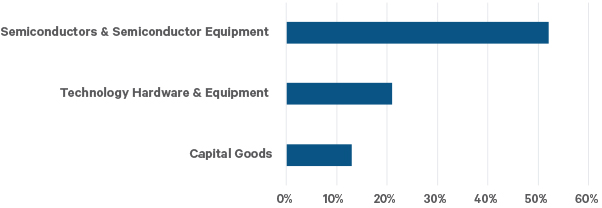
This year, it’s more informative to go below the sector level and segment the market into its industrial groups, of which there are twenty five. On this basis, the top three contributors are Semiconductors and Equipment, Technology Hardware and Equipment, and Capital Goods. All three are heavily exposed to datacentre related inputs, from chips to networking and power equipment.
In the first half, Semiconductors and Equipment accounted for more than half the return of global equities. Add Technology Hardware and Capital Goods and you’re close to 90% of the move in markets. This is narrow performance, focused on one play, the building of datacentres to power AI.
Figure 1: Top three contributors to global equity returns by industry group
Source: Bloomberg, MSCI, AC World Index. December 31st 2025, to June 30th, 2026.
Bailed out by the bots
Since the beginning of the war in Iran, global equities have risen 10%. There are almost 2,500 stocks in the global universe and if you look at the median stock return, the middle performer is down 1% since the end of February. So, the conflict in the Middle East has impacted the market, it’s just been offset by massive moves in the beneficiaries of AI related capital spending, led by a 52% jump in the Semiconductors and Equipment industry group.
Drilling down to stock level, nine of the top ten contributors to the market year-to-date are companies that develop or manufacture semiconductors and semiconductor equipment. The top three, Micron, Samsung Electronics, and SK Hynix, are members of an exclusive club that mass produce High Bandwidth Memory (HBM).
The enormous data processing requirements of Generative AI models, like OpenAI’s ChatGPT and Anthropic’s Claude, depend on small, fast, power efficient HBM. Without this memory capacity the models couldn’t function, and the AI revolution would grind to halt. Without the AI spending boom driving the stock market and boosting the economy through investment and wealth effects, the damage from the US administration’s military operation in the middle east would have been more apparent.
An artificial cycle
Semiconductor production is one of the most capital-intensive industries in the world, requiring tens of billions in upfront and ongoing investment. The sector has consolidated around a few large manufacturers that enjoy significant barriers to entry. High fixed costs, combined with fluctuations in demand, lead to boom-bust investment cycles, with periods of overcapacity and underutilisation.
We can see this cyclicality in the operating history of Micron, with the company losing money in six of the last twenty years. The shares are up more than 300% year-to-date, in local currency terms, and Micron is the top contributor to global equity performance.
The company’s earnings are forecast to leap 10-fold in the fiscal year ended August 2026 and to double again in fiscal 2027. In a memory ‘super cycle’ Micron’s capex is set to balloon over the next few years.
Will AI related demand drive further earnings upgrades for the semiconductor industry and a sustained period of high profitability or will ramping capex collide with a downturn in orders? The bulls say ‘this time will be different...’
Rising earnings, contracting multiples
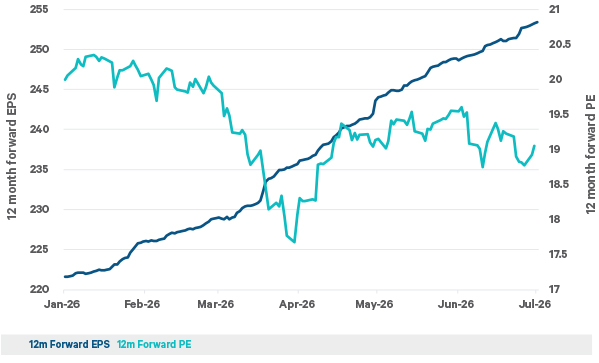
The traditional valuation metric for equities is the price to earnings (P/E) multiple, comparing the market value of a company to the earnings that it generates. Since the start of the year, the P/E for the Developed World index has contracted even though the market has gone up. Earnings forecasts have risen but the overall multiple applied to those earnings has declined. The blue line in the chart below shows earnings forecasts sailing straight through the closure of the Strait of Hormuz, helped by huge revisions to earnings forecasts for chip makers.
Figure 2: MSCI World Index price to earnings multiple and forecast earnings
Source: Bloomberg, July 1st, 2026.
The semiconductor companies are dependent on the continued largess of the technology giants that are building the datacentres and devouring all those chips. The so-called hyperscalers, Amazon, Alphabet, Microsoft, Meta and Oracle, are set to spend US$700bn on their AI arms race this year. Despite rising earnings estimates, all their valuation multiples have contracted. Without sufficient returns on their spending, they will come under pressure from investors to cut back.
Another side of the AI story is the decline in the share prices of the Software and Services industry on concerns that AI Agents will destroy or at the very least impair their business models. Earnings forecasts for the group as whole have continued to climb while the P/E multiple has fallen more than it has for any other industry group.
In the fog of the ‘SaaSpocalypse’ investors can’t see past the next couple of years and are discounting the terminal value of software businesses. Contrast that with semiconductor companies where buyers are happy to play the next couple of years of a super cycle and worry about the fallout later.
Out of this world
In early June, market news was dominated by the largest public offering in history: SpaceX listed at a valuation of US$1.8trn. This is a company with a very modest goal: ‘changing mankind and making us a multi-planetary species!’. It has three businesses: a satellite operation, a rocket launcher, and an AI division which includes X, formerly Twitter.
The 200,000-word prospectus told a wonderful tale about a lunar economy, in-orbit manufacturing and asteroid mining. It described a total addressable market of US$28.5trn, most of which, about US$23trn, covered the application of AI in corporations. Bringing those giant numbers back to our home planet, the gross domestic product of the US today is about US$32trn. So, SpaceX’s future target market is roughly equivalent to the size of the world’s largest economy.
Last year, SpaceX generated revenues of US$19bn and it was loss making. With no earnings, the traditional P/E valuation multiple has no application, investors must go up the profit and loss account and compare its valuation to sales. SpaceX came to the market at 90 times sales.
The company grew its revenue by 33% in 2025 but it lost US$4.9bn due to heavy spending on capex for AI development. Starlink, the satellite business, is the key asset. Last year its revenue was US$11.4bn, over 60% of the group. Starlink is profitable, but its earnings are more than offset by the losses incurred launching rockets and building compute capacity.
Goldman Sachs, the lead investment bank for the offering, expects SpaceX AI business to grow its revenue from US$3bn last year to over US$300bn by 2030, which is only three and a half years away. Expectations are high, to say the least. It brings back memories of the IPO mania during the Dot.com era.
Life on earth
A week before SpaceX listed, Alphabet announced plans to raise almost US$85bn in equity to help fund its AI infrastructure investments. It marked a big change for a company that was buying back stock for the last few years. With a US$4trn valuation, the new shares only represent around 2% of the market capitalisation.
Unlike SpaceX, Alphabet is a very profitable company. In the most recent quarter, it grew its revenue by more than 20% and its operating income by 30%. As a hyperscaler, it is spending a huge amount on capex: US$185bn this year, with plans for more next year.
In a notable endorsement, Alphabet’s capital raise included a US$10bn placement with Berkshire Hathaway. Berkshire already had a position, which it built up last year. The additional purchase makes Alphabet one of its largest holdings.
Along with the Alphabet investment, Berkshire also announced a more ‘Warren Buffet’ kind of deal that week. It acquired the home builder Taylor Morrison Home for US$8.5bn, or 12.5 times earnings. The US home building industry has been impacted by relatively high mortgage rates and Taylor Morrison’s sales were flat last year. This is the kind of company that Buffet, now retired, snapped up for decades. A good business in an out of favour industry, so buy it at an attractive price.
SpaceX came to market at 90 times sales. Alphabet issued equity at 10 times sales. Taylor Morrison Home was taken private at 1 times sales. Now home building is far lower margin than Alphabet’s search, advertising and cloud operations, but Taylor Morrison is profitable, unlike SpaceX. High expectations versus low expectations. Why build houses on earth when you can establish a human colony on Mars? Speculators can shoot for the stars while investors can shop for bargains closer to home.
The market as a whole has rallied through an energy shock this year but look below the surface and lots of stocks have been left behind. As an investor, you can have selective exposure to growth themes, like AI, but if you’re patient you can also tuck away a few, less exciting bargains.