In 1926, when James and Eugene Davy opened the doors of their new business, Ireland was a young Free State, predominantly rural, economically fragile and still recovering from years of political upheaval. One hundred years later, Ireland is one of the world’s most globalised economies and Davy is celebrating its centenary. The journeys of both Davy and the country reflect a century of extraordinary change.
Given the significance of this milestone, it has prompted much reflection on where the company has come from and where we sit today. The Davy publication, 100 Years in the Making, released this year, recounts the history of Davy. In doing so, it also tells the story of modern Ireland. Davy’s evolution mirrors the development of the Irish economy, chronicling many of the defining moments in Irish corporate history from the foundation of key institutions to the growth of indigenous industry and the emergence of internationally successful Irish businesses.
Another excellent publication released this year is The Story of Us by Orlaith McBride and John Gibney which provides an in-depth analysis of the 1926 census. It provides a unique look back in time, offering a lens into the Ireland in which James and Eugene Davy founded the business.
The front cover of The Story of Us is a photograph of a man driving a horse and cart in Frenchpark, Roscommon, while the back cover is an image of two cars driving on a street in Donnybrook. The images themselves almost serve as a metaphor for Ireland’s economic journey, from rural and agricultural Ireland to a more modern future.
James and Eugene in their wildest dreams could not have foreseen the change that was coming in the century ahead.
International landscape: A decade of change
Davy was formed in what we now know as the ‘Roaring 20s’, a period in post-war America that saw strong economic growth, rising incomes and significant technological and social changes. Two of the most influential technological advances were the widescale rollout of electricity across America and the mass adoption of the motor car.
We can only speculate as to what James and Eugene thought about these developments and whether they believed such technologies could ever be adopted at scale in Ireland.
Other notable developments in 1926 that would have major future implications:
- John Logie Baird gives the first demonstration of the television.
- The first transatlantic phone call was made from London to New York.
- Robert Goddard launches the world’s first successful liquid-fuel rocket in Massachusetts. Modern space travel traces its origins to this event – 100 years on we are still fascinated with the space economy.
- Thomas Edison, inventor of the record player, declares the radio a commercial failure. “The radio is a commercial failure, and its popularity with the public is waning.” - Radio Éireann also shares a birthday with Davy having also been established in 1926.
- Perhaps the most consequential event of all was one whose significance would only become fully apparent in the years that followed. In 1926, Adolf Hitler published the second volume of Mein Kampf. Within little more than a decade, Europe would descend into war, reminding us that history is shaped not only by innovation and progress, but also by darker forces.
At the time, these developments would have been little more than news items for James and Eugene to read, discuss and interpret. The eventual impact of these innovations was far from obvious. A century later, we can clearly see their significance.
Today, we find ourselves in a similar position. We read daily headlines about Artificial Intelligence (AI), humanoid robots, autonomous vehicles, quantum computing, commercial space travel, synthetic biology and fusion energy. One hundred years from now, future generations may look back and wonder how obvious the winners were. They may view the emergence of AI the way we view electrification, or regard autonomous systems as we regard the arrival of the motor car. Equally, some technologies attracting enormous attention today may ultimately prove less transformative than expected.
The challenge for every generation is that history is only obvious in hindsight
Both men were young and ambitious in 1926, embracing the new Free State economy. No doubt they started the business with the best laid plans. However, the macro backdrop was far from straightforward.
- Dublin was still in rebuilding mode post the 1916 Rising and the Civil War.
- Approximately 70% of the population lived in rural areas.
- Unemployment and emigration were both trending in the wrong direction.
- Life expectancy for those born in 1926 was just 55 years of age.
- Relations with the UK were strained, while the political situation at home remained challenging in the years following the Treaty.
- Irish whiskey, one of Ireland’s leading exports, suffered heavily due to US Prohibition.
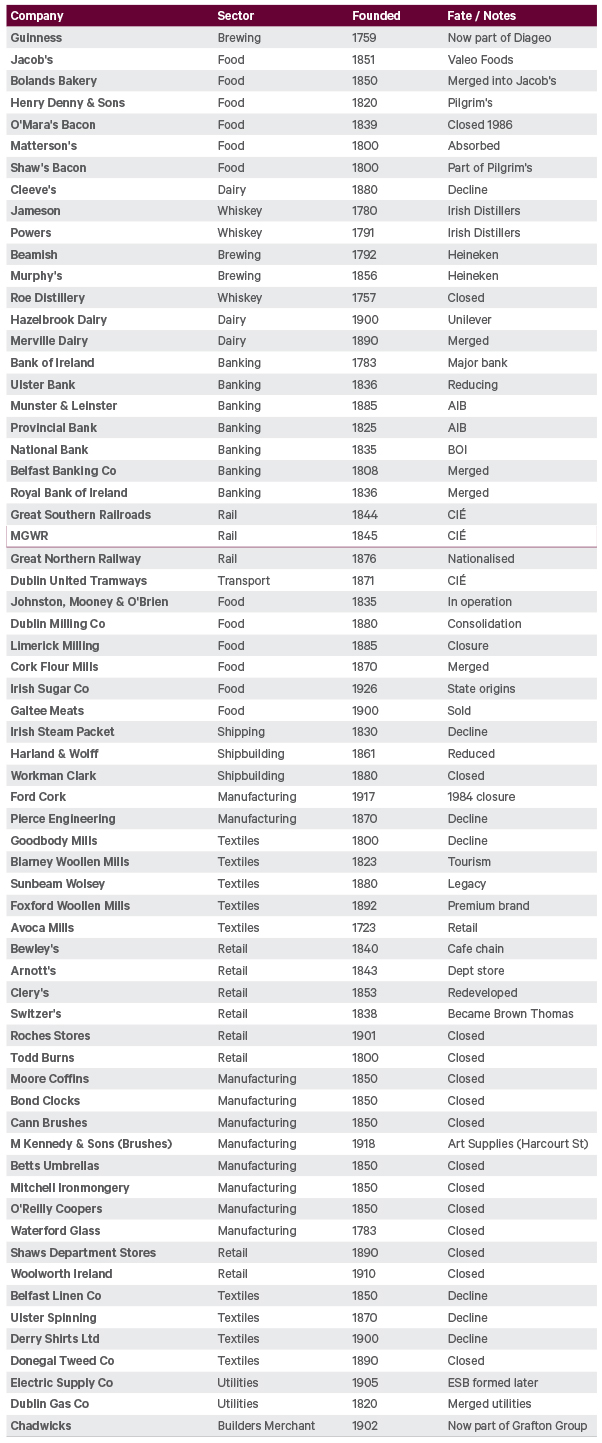
Against that backdrop, James and Eugene could have been forgiven for deciding not to start at all. However, the Davy brothers were not alone in looking to forge a new path forward in what was an emerging Free State. The table at the end of this publication is a snapshot of some of the businesses operating in Ireland at the time.
In the case of the railroad and tram companies, few in 1926 would have foreseen the decline that was coming, yet with the benefit of hindsight it was perfectly obvious. The first Dublin Bus route began operating in 1925, running from Eden Quay to Killester. This, along with the rise of the motor car, led to the eventual closure of the tram system in 1949.
Milling was another industry that appeared indispensable in the 1900s. Most towns had a local mill supplying flour to nearby bakers and households. Yet advances in milling technology, combined with the economic advantages of scale, gradually shifted production to larger and more efficient operators. By 1920 even the larger mills were impacted as imported flour from the UK was being ‘dumped’ on the Irish market.
In The Story of Us, it reviews the advertisements from various newspapers on the census day, April 18th, 1926. Some of the more interesting references include:
Hazelbrook Farm in Rathfarnham was promoting a new product called HB Ice Cream, first manufactured in 1926. The business emerged as a practical solution to utilise surplus milk from the company’s dairy operations. Decades later, it would become one of Ireland’s most recognisable consumer brands and eventually find its way into the Unilever portfolio.
The story feels surprisingly familiar. Almost a century later, Glanbia developed a global sports nutrition business from whey, a by-product of cheese production. In both cases, innovation emerged from finding value in what others saw as surplus.
Familiar brands advertising include – Fox’s Glacier Mints, Kraft Cheese, Lipton’s Tea, Fry’s Chocolate Cream tablets and HP Sauce. From Figure 2 some of the companies may have disappeared or been subsumed into other entities but brands such as Jacobs, Denny and Murphy's still exist to this day. Guinness and Jameson are two of the most identifiable and valuable global brands.
Some of the manufacturing companies like Betts Umbrellas, Bond Clocks and O’Reilly Coopers point to a different time. In retail, some familiar names with Bewley’s, Arnott’s and Switzer’s (now Brown Thomas) still standing 100 years on.
Investing for decades and centuries, not weeks and months
One of the most powerful forces in investing is compounding. The best companies create value over decades, reinvesting capital, adapting to change and steadily growing earnings. Yet investors often evaluate businesses over months rather than years. A study by CIBC in 2025 calculated that for the total US market, the average holding period for a stock has decreased from 8.7 years in 1970 to 0.6 years in 2025.
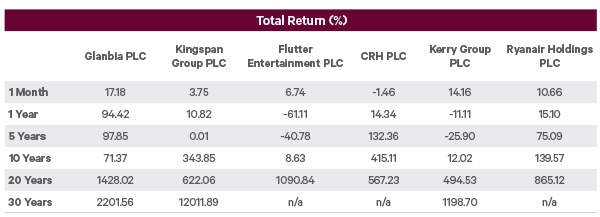
Figure 1 below details the total returns of some of Ireland’s most successful companies over various time periods. Short-term returns will always be more volatile, as both macroeconomic and company specific factors influence performance. However, high-quality companies such as these, with proven track records of adapting, have demonstrated an exceptional ability to create long-term shareholder value. As Benjamin Graham famously said, “In the short run, the market is a voting machine, but in the long run, it is a weighing machine.
Figure 1: Total return of some leading Irish companies
Source: Bloomberg. The returns are to 30/06/2026.
Kerry Group may have started as a dairy business, but it quickly recognised the opportunity in dairy ingredients over liquid milk. Over multiple decades it has moved up the ingredients value chain and expanded internationally. Management saw an opportunity and followed its customer base all over the world. It is now one of the leading ingredients companies in the world.
Kingspan started out by selling trailers to the agricultural sector in Ireland before seeing the opportunity in factory-built construction products. This pivot spawned one of the most successful Irish businesses of all time. Kingspan today is a global construction materials company valued at €14bn. Like all good businesses it continues to invest for the future – be that research and development into new products and/or geographic expansion.
At the point of its IPO in 1997, Ryanair flew four million passengers. This year it will fly circa 210 million. However, would it exist today had it not adapted to the internet at the pace at which it did? Whilst other competitors saw internet booking as a ‘nice to have’, Ryanair went all in, making significant savings on fees previously paid to travel agents. These savings enabled Ryanair to open a moat that to this day is still intact and indeed widening.
As the internet was in its infancy in the 1990s, Ryanair would not have been an obvious winner – yet the internet proved to be a massive enabler. This serves as a reminder that as we look forward to who the winners (and losers) from the adoption of Artificial Intelligence across business is that it may not be in the most obvious places.
The last century taught us that industries evolve, business models change, and technological breakthroughs create both winners and losers. Some companies adapt and thrive. Others fail to recognise change until it is too late.
In 1926, James and Eugene Davy could not have known which of the day’s headlines would shape the century ahead. We are no different. Today’s news cycle is filled with developments in artificial intelligence, robotics, biotechnology and energy. Some will transform the world. Others will be forgotten.
The challenge for investors is not to predict the future with certainty. It is to identify the businesses most capable of adapting to whatever future emerges.
One hundred years after its foundation, Davy’s history reminds us that progress is rarely linear, that change is constant, and that the greatest opportunities often emerge long before their significance becomes obvious.
Figure 2: A snapshot of companies in operation in the early 1900s
Source: Davy. The Founded and Fate/Notes columns are based on publicly available information and have not been independently verified. As such, inaccuracies may exist, and the information should not be relied upon as factually correct.