What a remarkable year we just experienced. True to his word, President Trump went bigger and bolder than before. He took a wrecking ball to global norms and institutions, pushing his personal and America First agendas to new extremes. And yet stock markets were up double digits (in US dollars) again. How can this be? More importantly, can it continue?
Figure 1: Asset performance 2025
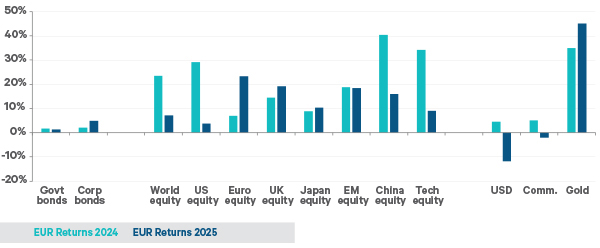
Source: Bloomberg, MSCI. 'Comm' is short for commodities. All are total returns in euro. Bond returns are hedged to euro.
Throughout the year, there were many unsettling events for markets. Trump’s trade tariffs were much harsher than expected, and between them, the United States and Israel bombed Iran, Qatar, Nigeria, and Venezuela. Yet again, though, we were reminded that markets are ultimately driven by economic growth and corporate earnings, which both remained solid.
Focusing just on the economics and markets, there are still serious concerns, like jobs, deficits, and asset valuations. In our outlook for 2026, we investigate the durability of this debt-laden economic cycle, and how much further the technology-fueled bull market can run.
It’s the economy, stupid1
It was tough to get a good read of the US economy in 2025, with the extreme trade swings in the first half of the year and the government shutdown later on, but we didn’t need MAGA glasses to see the positive data. Compared with the end of 2024, the US economy now has higher growth, lower inflation and energy costs, lower interest rates, and a more favourable exchange rate. No wonder that Treasury Secretary Bessent boasts of the Trump administration’s performance.
Figure 2: Composition of US GDP growth 2020-2025
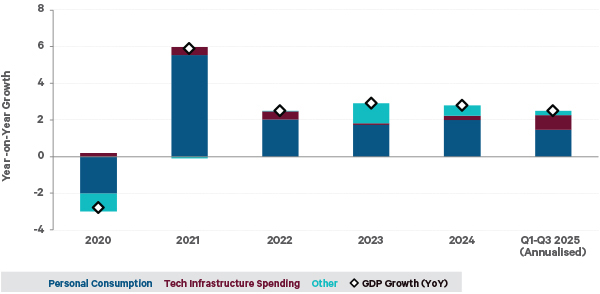
Source: Bureau of Economic Analysis. GDP is gross domestic product, the standard measure of national economic growth.
Of course, the reality isn’t that simple. First, after missing a month due to the shutdown, consumer price inflation (CPI) only dipped below the end 2024 level in the last month of 2025 due to a surprise drop in rental inflation. It will take more time for Trump’s tariffs to pass out of the prices data, and in the meantime, US consumers are angry.
A breakdown of US GDP2 in Figure 2 shows that the engine of the economy, consumer spending growth, slowed in 2025. The K-shaped economy is back, with a growing gap between higher and lower income groups. The extent of the divergence is debated, but retailer earnings reports indicate that lower income groups are feeling more of the squeeze and tightening more.
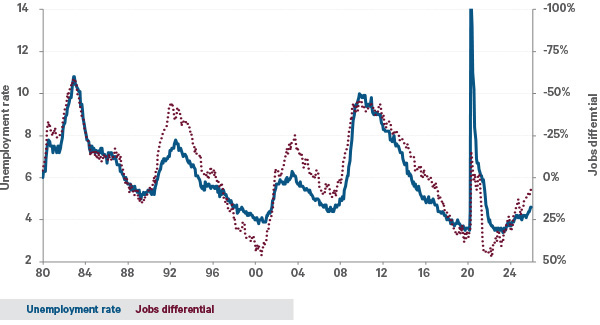
Our biggest concern is the labour market. As trade war uncertainty hit blue collar jobs and artificial intelligence (AI) began to impact white collar work, 2025 saw a worrying decline in job growth and a rise in unemployment (Figure 3). In fact, without the fall in immigration the unemployment rate could be around 1% higher, suggesting a weaker economy and putting consumer spending at risk.
Figure 3: US unemployment rate and job availability
But it is not all doom and gloom. The first quarter of this year will see the rebound of activity postponed in the fourth quarter shutdown last year. Trump’s OBBBA (One Big Beautiful Bill Act) will kick in too, with tax cuts to support household and business spending and huge investment incentives for corporates. As Figure 3 shows, investment in AI has already been a noticeable boost to the economy.
With lower borrowing costs, a strong stock market and a cheaper currency, financial conditions are more favourable in 2026 for US companies and households. The Federal Reserve (the Fed) is focusing more on jobs than inflation now, so interest rates will go lower, whoever becomes the new Fed chair. And lastly, if Trump is still lagging badly in the polls, we would not rule out further stimulus before the mid-term elections in November.
There will eventually be some payback for all this policy generosity, not least when the cuts to healthcare land, but for now, combined with the investment boom in AI, there are strong enough tailwinds to keep the US economy away from recession. We plan to keep a watch on jobs and consumer spending.
Beyond America first
If AI and fair policy winds overcome the trade war and higher inflation in US, how about the rest of the world? Even though tariffs were much worse than expected, European and Asian economies were not hit as hard as feared, partly because the costs were mostly borne on the US side, and partly because there was little self-harming retaliation.
The Eurozone now has the benefit of lower interest rates and energy prices, and fiscal policy will be expansionary in 2026, with higher defence spending across the bloc and more infrastructure spending in Germany to offset any French attempts at budget consolidation. Southern Europe, particularly Spain, continues to outperform, quite the turnaround from the past.
The United Kingdom resembles a lower growth version of the US, in that inflation remains above target and unemployment is creeping up. Like the Fed, the Bank of England (BOE) is focusing more on jobs and is cutting rates again. Unlike the US, there is no AI boom, and markets are less forgiving, so the government is being forced to address its imbalances sooner. Unfortunately, it is not doing a convincing job, and the BOE may be forced to help.
China has had a better trade war than expected, playing their rare earth cards effectively to neuter the worst of the US tariffs. Their ex-US exports have grown impressively, overtaking Germany as the largest exporter of cars, but this only makes up for the continued slump in their property sector and the associated weakness in consumer demand. With no inflation and rates already very low, more stimulus will be needed to boost the domestic economy.
Figure 4: 2025 government deficits and 2026 fiscal policy impulse
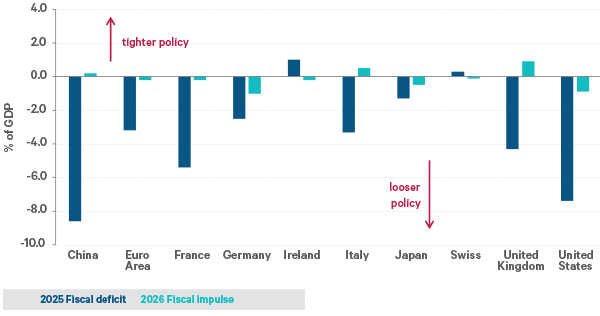
Source: International Monetary Fund (IMF), US Congressional Budget Office (CBO). The fiscal deficit includes interest cost. The fiscal impulse is the forecast change in deficit (excluding interest costs).
Bond vigilantes in the back end
So once again we find, to varying degrees, that governments spending beyond their means will support most major economies, while their central banks support them in the bond markets. As we highlighted last year, the interest cost of accumulated debt is approaching unsustainable levels in some countries, and, as Figure 5 shows, the arithmetic did not improve in 2025.
Figure 5: Government debt levels and borrowing costs (as % of GDP)
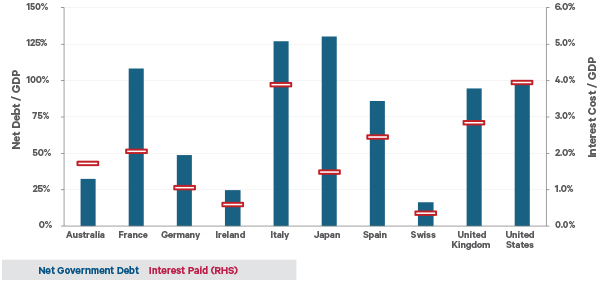
Source: IMF, 2025. Interest paid reflects 2024 figures. Government debt is shown net of internal holdings. GDP is gross domestic product, the standard measure of national economic growth.
Yet for those, including ourselves, who have wondered how long bond markets would tolerate such fiscal laxity, 2025 brought several important developments. The most dramatic came in early April, when President Trump’s Liberation Day tariffs led to a spike in US treasury yields, and he was forced to postpone his plans, to avoid the US suffering a Truss-style crisis3.
The second change was slower. While treasury debt agencies focused more on the front end of the bond curve, i.e. shorter-term bonds, yields on 30-year bonds drifted up to levels not seen in decades, as investors demand more compensation for the rising risks of long-term government debt. This upwards shift was most pronounced in the UK and Japan. See figure 6 below.
Figure 6: 30-year government bond yields
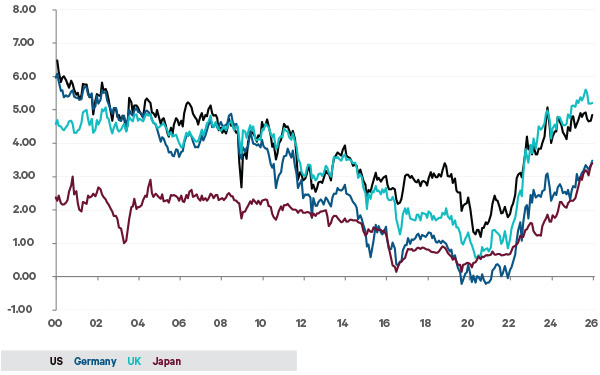
Source: DataStream. Each bond yield is quoted in the local currency.
As April’s tariff turnaround showed, the Trump administration is aware of this financing risk, but as the UK Labour government has found, balancing the budget is not straightforward. So, the US government is trying other interesting ways to shore up their debt, as the revenue from trade tariffs will not be enough.
Last year’s GENIUS act, the regulatory framework for digital stablecoins4, includes tighter collateral rules, requiring providers to own treasury bonds to back their coins, and this year they are exploring changing bank leverage ratios, allowing them to expand their balance sheets. Both changes could create significant demand for US debt and keep yields from rising too far.
Of course, as we saw in 2025, bond yields are not the only way that markets can signal their disapproval. Reckless policies can be reflected in the exchange rate as well.
Figure 7: 2025 in perspective – annual dollar performance back to the 1980s
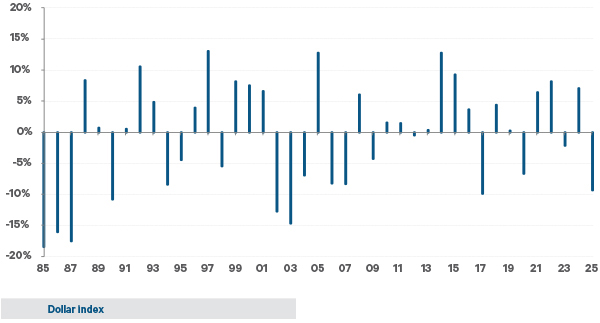
Source: DataStream. Each bond yield is quoted in the local currency.
Has the dollar been dethroned?
This time last year, the consensus was that a hotter economy under President Trump would keep US rates higher and the dollar strong in 2025, a view that quickly evaporated once he took office. As he pushed his radical policies, the dollar fell and a panic almost set in. Yet despite all the noise, last year's decline was not exceptional by historical standards (Figure 7).
Looking forward, it is still true that US deficits and debt are uncomfortably high, and inflation is still a near-term and long-term concern, but this so-called ‘debasement risk’ is not unique to the US. The dollar interest rate advantage shrank in 2025, and will shrink further this year, but this is already partly priced into current exchange rates.
One concern that resurfaced last year is the risk to the dollar’s status as the world’s reserve currency. The constant flow of global capital into US markets did stall in April, but as we see in Figure 8, it resumed quickly once the trade war calmed. It is not a satisfactory situation, but there are simply no other markets broad and deep enough to absorb the world’s savings.
Figure 8: Foreign purchases of US assets in 2025
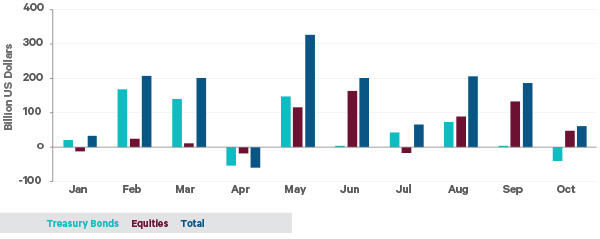
Source: US Treasury Department, December 2025.
What is different about the dollar now is that the Trump administration has made a weaker exchange rate an explicit policy goal. However, as Secretary Bessent clarified, this is not the same thing as a weaker currency. They still want a strong dollar to dominate the global economy and financial markets, but at a more competitive exchange rate to help US companies.
We are sympathetic to the dollar bear case, although we believe that most of the depreciation has already happened, particularly against European currencies. Since Trump policy risks are still high, we do maintain some dollar hedges in our portfolios. If anything, we see more upside in Asian and emerging market currencies, which have more room to appreciate.
Are we in an AI bubble?
One obvious reason for capital flows into the US is that almost all the largest stocks in the world are American. Despite bear markets in 2020 and 2022, the world index is up 112% (in dollars) this decade so far, but the gains have been noticeably K-shaped, with large cap US tech firms (up 254%) dominating all other regions, sectors and styles.
In fact, if we focus even further, the Magnificent 7 group of stocks5 is up 689%, and the UBS index of 'AI winners' is up 908%, over the same period. This astounding performance naturally raises the question – are we in an AI bubble?
Without getting stuck on exact definitions, bubbles are usually caused by a new idea or technology (in this case AI) which gives rise to irrational exuberance and ‘FOMO’ behaviour6 among investors. This pushes asset valuations beyond levels that can be realistically explained by the prospects for future profits.
In the current environment, we see that the out-performance of US mega technology stocks this decade has not been that irrational; it’s been largely driven by their superior earnings growth. It is also worth noting in Figure 9 that the valuations of today’s leading stocks, many of which are too high for our tastes, are still comfortably below what we saw in previous bubble episodes.
Figure 9: Valuations for the Magnificent 7 compared with top 7 stocks in historical bubbles
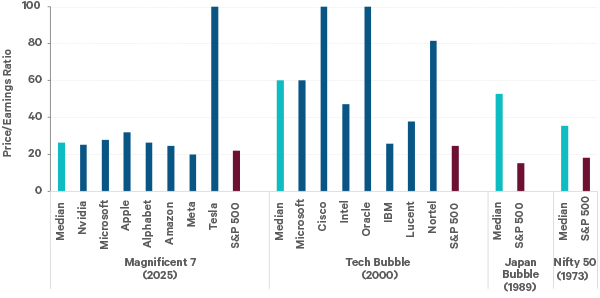
Source: Davy, Bloomberg, Goldman Sachs, Shiller. As of 31/12/2025. For Magnificent 7 and Tech Bubble we use forward earnings, and for Japan Bubble and Nifty 50, we use trailing earnings.
Also, unlike the 1990s tech bubble, we have yet to see a rush of AI IPOs or debt issuance, as the largest players, the ‘AI hyper-scalers’, have funded their investments from their enormous profits. But we do note the recent rise of off-balance sheet funding vehicles to finance data centres, and circular deals between producers and users of AI chips and computing power.
Lastly, when FOMO takes over, the rising tide tends to lift all related boats. As the variation in the Magnificent 7’s 2025 performance shows, investors are not buying indiscriminately. They are trying to distinguish between companies whose AI plans seem plausible and those whose sums do not add up.
In fact, if there has been FOMO behaviour, it has been more in the technology companies themselves, with their colossal spending plans. This makes more sense for hugely profitable companies, who can afford to lose money to stay ahead of their competitors, than it does for investors who seek a reasonable return on their capital.
In summary, we do not see an AI bubble yet. We see an exciting sector with unknowable potential, that is dominated by highly profitable companies at very high valuations. Where we do see froth is in the fringes – earlier stage companies, both public and private, are attracting eye-watering valuations, as speculators seek lottery ticket investments.
Fight or follow the flow?
So, if we are not close to a recession, government policy is supportive, and the stock market isn’t in a bubble, shouldn’t we just buy the index and enjoy the ride? Or while we’re at it, why not buy more of the index?
There are at least two arguments for such a course of action. The first is relatively new – we have an administration in the White House that has an active interest in the success of the technology and AI sectors (and more so crypto). The second is a long-running trend – the relentless flow of money into passive products, such as ETFs7, that simply buy the index.
These are important questions that we are actively researching in Davy, and 2025 was an interesting case study. At the start of the year the Magnificent 7 stocks were the largest in the index (US or global), yet despite all the passive flows into the market, only two outperformed the index on the year. So, there must be more to it than just flows. What about fundamentals?
As outlined above, we do not think that stocks are in a bubble. However, because valuations are below the extremes of 1999 does not mean that they are reasonable. Measured against its own history (including the late 1990s), the price / earnings ratio of the US index, currently at 22x, is above the 90th percentile (see figure 10)8. At 20x, the world index is above its 85th percentile.
Figure 10: Valuations of major indices vs historical range since 1995
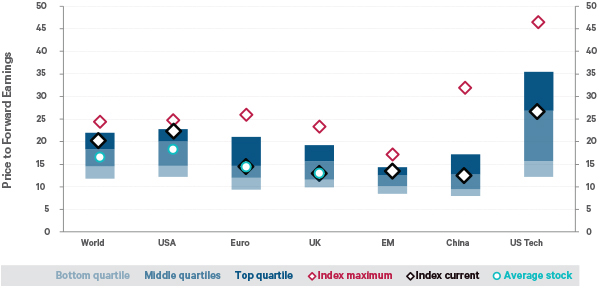
Source: MSCI, Davy calculations. Covering the period from 1995 to 2025. Each regional index is in local currency, except World is measured in dollars.
However, the average stock in the US and world indices is trading at more modest multiples, at 18.5x and 16.5x, meaning that the index valuations are being skewed upwards by the largest companies. By contrast, after strong 2025 performance, Euro (15x), UK (13x) and Chinese (16x) multiples are trading in their 70th, 50th and 70th percentile ranges.
Also, these price / earnings multiples are built on ambitious earnings forecasts. While we don’t doubt the transformative potential of AI, we do doubt that most of the largest tech companies can continue to grow profits at these rates (see Figure 11), given how much capital they are investing and that they are now competing with each other.
Figure 11: Valuations vs earnings forecasts (2025-27)
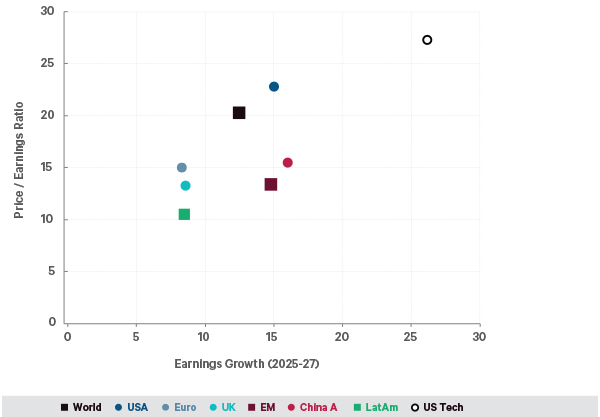
Source: MSCI, Davy calculations. For Price / Earnings we use 2026 forward earnings. For Earnings Growth, we use 2025 actual and 2026-27 forecast earnings.
There will undoubtedly be big winners from AI, but so much must go right to justify the current expectations and pricing that there is much higher risk of disappointment in US technology stocks compared with other sectors and regions. As for passive flows, we saw in 2022 and April 2025 that these can go in the wrong direction too, dragging down the largest stocks.
Even though Europe and emerging markets are no longer cheap alternatives, the risk-reward mix is still more attractive and there is more room for upside. If the earnings growth gap narrows, either because the US disappoints or Europe improves, the size of these markets compared to the US means that capital flows could boost returns in 2026 as they did in 2026.
Lastly, as for the argument that the Trump government have a vested interest in the success of the US stock market, this is even more true of the smaller and more malleable crypto market, and we can see that worked out last year.
Investment conclusions
To summarise our macro view, we believe that the US economy will have enough momentum from favourable policy (lower borrowing costs, deregulation, tax cuts, and incentives) to overcome the risks to consumer spending from inflation and a weaker labour market. We will be watching the jobs numbers closely to see if this changes.
Outside the US, Europe and Asia have weathered the trade war surprisingly well. We expect more government stimulus across the Eurozone, particularly in Germany, while the UK undergoes some belt-tightening. Chinese exports and manufacturing are growing robustly, but their property and consumer sectors remain weak.
Even though inflation may remain above the official 2% target, we expect more rate cuts in the US and UK, but not in the Eurozone. While fiscal fears continue to mount, we expect this to remain an issue for the longer end of the bond market and not the part we invest in. If trouble does emerge, we believe that central banks have enough firepower to keep a lid on yields.
Given such a ceiling on bond yields, policy concerns may play out as much in exchange rates as in bond markets. The more vulnerable currencies are likely the dollar and the pound, so we maintain some currency hedges, and if current geopolitical events remain contained, we see upside in Asian and emerging market currencies.
Commodities are typically more sensitive to geopolitics. We were surprised that gold did so well in 2025, and there is risk of a correction this year as more people jump on or off its hot streak, but we maintain our strategic holding as a diversifier and an insurance policy against the unknown, albeit a more expensive one than before.
As for stock markets, we do not believe we are in an AI bubble, but US indices are expensive, and earnings expectations are stretched. Our base case is not a technology crash, and betting against the market is generally a losing strategy, but we know that markets can be sensitive to disappointment, and the most stretched assets are the most vulnerable. Therefore, we look to diversify into other geographies and sectors where the opportunity set is more compelling.
This time last year, all we could say with any confidence was that the range of potential outcomes had widened, and that our portfolios should reflect this. We were encouraged to see diversification work so well in such a volatile year. If anything, the range of outcomes this year has widened even further, and diversification is still the best approach to deal with it.
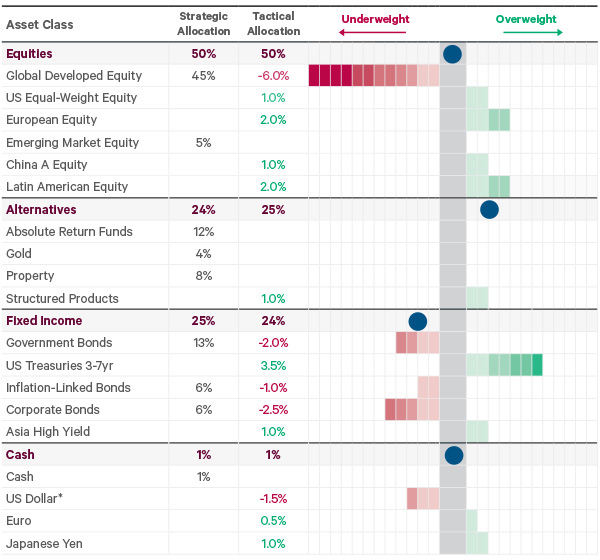
Portfolio Positioning for 2026
Figure 12: Current positioning for EUR moderate growth portfolio