President Trump, Artificial Intelligence (AI), mega-cap dominance, and the US valuation premium: as we enter a new calendar year, we could almost copy and paste the big themes from January 2025. Twelve months ago, central bankers were expected to support economies by lowering interest rates, which they did – and more cuts are anticipated in 2026.
Protectionism was a simmering risk, that reached boiling point in April, as the US tariff shock sent the S&P 500 into bear market territory1. Today, somewhat calmer trade waters are forecast, as deals have gradually been announced.
After an extended period of underperformance, equity indices outside the US finally beat the S&P in constant currency terms. Although, from early April, as markets recovered from the Trump trade thump, it was the trillion-dollar US technology stocks that led the rally.
Following two years of double-digit returns, and despite all the noise and disruption, equities continued to make progress in 2025. Fears that the trade war would cause a recession, a spike in inflation, and a collapse in investment, proved unfounded. Companies got on with business, and economies were resilient. A weaker dollar did limit returns for euro-based investors.
It is reasonable to expect more ups and downs this year. The US president’s instincts may be tempered by the approaching mid-term elections, but there will always be geopolitical events. World equity indices remain highly concentrated – the US accounts for two-thirds of the global market and almost three-quarters of developed world capitalisation. The largest ten companies make up 40% of the S&P 500, and eight of them are plays on AI.
At a high level, overall equity valuations are above long-term averages, and with double-digit earnings growth forecast, corporates need to deliver.
Figure 1: S&P 500 and MSCI Developed World excluding the US
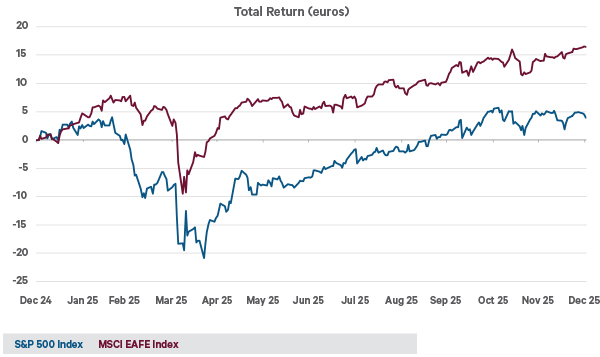
Source: Bloomberg. Total returns are in euro in 2025.
AI boom
AI infrastructure spend helped the US economy and stock market in 2025. Concerns that China might win the technology race quickly dissipated after start-up Deepseek revealed significantly lower model training costs.
Privately held ChatGPT maker, OpenAI, went on to announce deal after deal, spinning a complex web of cross shareholdings and purchase agreements with chipmakers Nvidia and Broadcom, cloud capacity provider Oracle, and even content owners like Disney. The major hyperscalers, the companies building the AI datacentres, increased their capex targets through the year and are set to spend over US$500bn in 2026.
The UBS AI Winners Index soared 44% in local currency terms in 2025. With the rise in share prices, comparisons to the TMT (Telecom, Media and Tech) bubble in the late ‘90s are inevitable, yet there are differences. Back then, internet mania drove telecom companies to build networks in anticipation of massive demand. Consumers would own multiple mobile devices; they would live online and download so much data. Of course, those predictions came true, but it took much longer than expected. Profitless companies came to market, debt financing was aggressive, and when the fever broke, equity valuations collapsed.
The Nasdaq peaked in March 2000 and by September of the following year, it had dropped more than 70%, wiping out all the gains since 1996. The index didn’t reach new highs again until 2015. Meanwhile, 70 million miles of excess fibre lay dark underground.
For today’s AI data centre builders, demand for their services exceeds supply and the leading-edge large language models have continued to improve. Most of the large players have strong balance sheets, they are funding capex through operating cashflow and they’re also developing applications for the new technology.
Financially stretched names are coming under more scrutiny; Oracle’s share price popped on news of a US$300bn contract from OpenAI, and then dropped as investors noted the funding strain. The bond market is policing spending. Although exposure in private credit is naturally less transparent.
The darlings of the Dot.com era traded at much higher valuations – the Nasdaq reached 60 times earnings in 2000. Multiples for the big three hyperscalers - Amazon, Microsoft and Alphabet – range between 25 and 28 times earnings, and they’ve delivered impressive growth numbers.
History doesn’t repeat but there are risks amid all the excitement about AI. New technology is disruptive and unpredictable, making it difficult to value. We need to see more use cases and productivity wins for the adopters of AI, from financials to healthcare, advertising to transportation. If demand continues to rise, power constraints could slow deployment. So, it’s important to be selective about exposure to Artificial Intelligence, and in a concentrated market, diversify beyond it.
Equal opportunities
We can dilute big technology’s impact on performance, and the appeal of AI, by looking at the equally weighted S&P 500, where every stock has the same importance regardless of size. The equally weighted index declined in euro terms in 2025.
Strip away AI, and you’ll find that lots of stocks were left behind. Expectations for them are lower and valuations are less demanding. It’s also notable that the equally weighted index was less pressured during the market rout in April.
Figure 2: Dissecting the US market in 2025 – the AI winners won
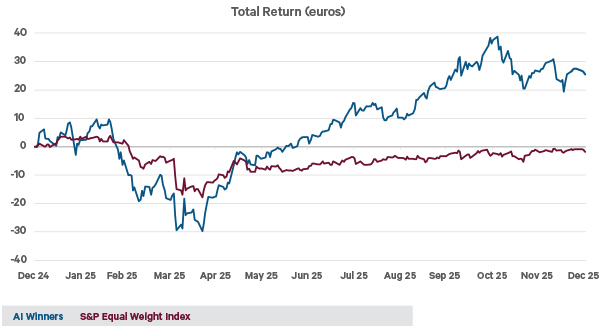
Source: Bloomberg. The equally weighted S&P 500 was down 2%. Figures are in euro terms.
It’s a similar picture outside the US. Emerging Markets rose in the high teens in euro terms in 2025. The top five contributors to that performance - including TSMC, SK Hynix and Alibaba - are all exposed to data centre infrastructure, and collectively they accounted for almost 60% of Emerging Market returns. In Japan, the top contributor to the MSCI index was technology investment holding company Softbank, while in Europe it was semiconductor manufacturing equipment maker ASML.
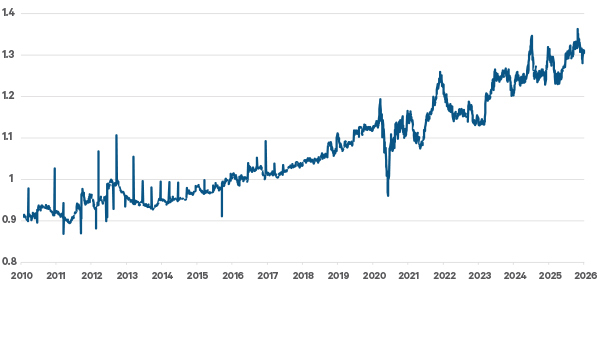
Mega-cap technology has driven the S&P 500 market cap weighted P/E to a 30% premium to the equally weighted market.
Figure 3: Ratio of the S&P 500 12-month forward P/E to the equally weighted P/E
Loosening up
The trade war shook investors early last year and it was Trump unleashed, until he was finally restrained by market realities. Some of the administration’s policies are viewed more positively. One is US banking regulation. Rules intensified following the financial crisis in 2008, and for good reason. However, critics believe the regulators went too far, driving lending to less supervised areas like private credit.
Removing excessive restrictions should encourage more lending and support economic growth. Researchers see planned reforms, some of which have already been approved, increasing lending capacity by up to US$2.6 trillion, while also improving sector profitability.
Regulators in the EU are unlikely to follow suit, preferring to simplify rather than loosen capital requirements, which may place regional players at a disadvantage.
A more deal friendly US administration has encouraged merger and acquisition activity, with 2025 the strongest year since the pandemic period of 2021. Globally, over US$4 trillion dollars of transactions were announced. The largest, is the highly contested battle to take over Warner Bros Discovery, owner of the Harry Potter franchise and HBO. The board agreed an US$83bn deal with Netflix and then rejected a US$108bn hostile bid from Paramount.
The opportunity to control a 100-year-old Hollywood studio has attracted the major powers of our era: big technology and political oligarchs. Netflix is motivated by its fear of Alphabet owned YouTube - the number one streaming platform on US TV screens. Paramount is led by David Ellison. His father owns 40% of Oracle, and he was a big donor to the US President.
Consumers split
One of the weakest sectors last year was Consumer Staples. It completely failed to participate in the rally from the market lows in April because low-income consumers are feeling the pinch.
Trump was elected on cost-of-living issues, which he then exacerbated with his trade war. This is an election year, and more than half of the lowest income states vote Republican. In November, the US cut tariffs on more than 200 food products ranging from beef to bananas to ‘Make America Affordable Again’.
Higher earners have enjoyed the wealth effect of a rising stock market, which ties back to the largess of the AI story. Individual investors account for 20% of US large cap volume, double the level it was five years ago.
Pharma heals
The Healthcare industry limped through most of 2025. Pricing pressure from the US administration, tariff risk, dollar weakness and concerns about upcoming patent losses drove investors away. Relative valuations for the sector reached extreme lows.
Then pharma executives announced win-win pricing deals, executed pipeline boosting acquisitions and revealed positive drug trial results. Add some sector rotation from the AI story, investors in search of a bargain, and Healthcare became the top performing sector in the world index in the final quarter of the year.
Top heavy
Collectively, world equities are trading close to 20 times twelve-month forward earnings which is a premium to the long-term average of about 16 times. A market concentrated in a small number of mega-cap stocks increases fragility, while eclipsing the value available in other companies. Nvidia alone accounts for more than 5% of the world index.
In the last decade, only one sector has outperformed the overall equity index – the technology sector. Will that repeat over the next ten years? If Artificial Intelligence lives up to the most optimistic visions, then well-managed, data-rich companies across industries should reap the operational benefits.
1 A bear market is a drop in the index price of 20% or more.