US equities finished the week higher. The FOMC delivered a unanimous 25 bps rate hike, with the 2026 median “dot” showing a strong consensus for one additional 25 bps rate hike this year. US retail sales rose 1.2% in August, reinforcing the economy's resilience despite inflation concerns.
Over in Europe, the final estimate for August inflation came in at 3.2%, slightly less than the 3.3% forecast. In the UK, inflation rose to 3.1% in August, with energy costs a major factor. The Bank of England held rates steady as expected, with Governor Bailey stating that policy "may have to tighten“ if the conflict in the Middle East persists for an extended period. Elsewhere, the Bank of Japan increased its target rate as expected to 1.25%, a 31-year high.
Last week's highlights
 |
- FOMC Meeting (16/09) – Hiked rates by 25 bps as expected, with Warsh stating that “inflation is too high and has been for too long”.
- US Retail Sales (16/09) – Rose 1.2% in August, reinforcing the economy's resilience despite inflation concerns.
|
 |
- Eurozone CPI – August (17/09) - Final estimate for August inflation came in at 3.2%, slightly less than the 3.3% forecast.
|
 |
- UK CPI – August (16/09) – Came in at 3.1% in August, with energy costs a major factor.
- Bank of England Meeting (17/09) – Held rates steady as expected, Bailey stated that policy "may have to tighten“ if the conflict in the Middle East persists for an extended period.
|
 |
- Bank of Japan Meeting (18/09) – Increased its target rate as expected to 1.25%, a 31-year high.
|
Looking ahead to this week, President Trump will meet Chinese President Xi Jinping, with talks set to cover tariffs, AI policy, rare earth supply chains, Taiwan, and broader US-China relations. Investors in the US will also receive S&P Global’s preliminary PMIs for September and data on new home sales. The Swiss National Bank is due to meet on Thursday and are expected to keep rates on hold at 0%. Finally, the People’s Bank of China will meet and is expected to leave rates unchanged.
What's on the radar
|
- S&P Global Manufacturing & Services PMIs (23/09)
- Trump - Xi Jinping Summit (24/09)
- New Home Sales (24/09)
|
|
- Swiss National Bank Meeting (24/09)
- HCOB Eurozone Composite PMI (23/09)
|
|
- S&P Global Composite PMI (23/09)
|
|
- People’s Bank of China Meeting (21/09)
|
Chart of the moment - Some crack
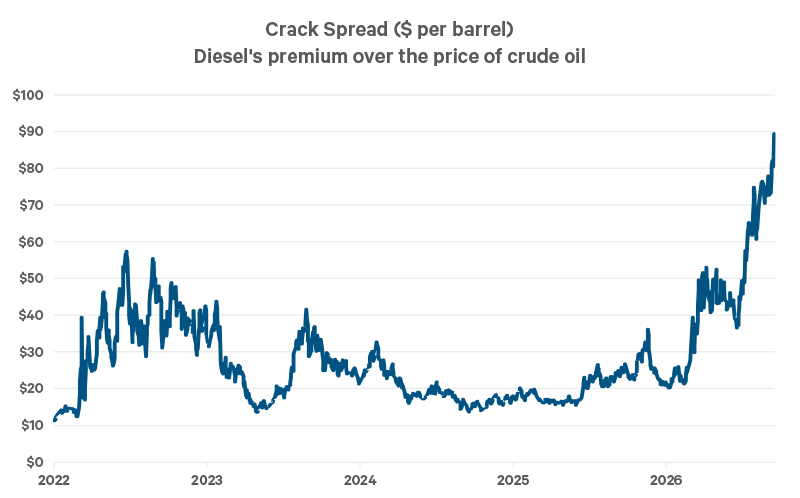
Source: Bloomberg as of 15/09/2026. Note: Crack spread shown is ICE Gasoil futures – ICE Brent futures.
- A crack spread is the profit margin a refinery earns from turning crude oil into products like petrol, diesel and jet fuel.
- These spreads have been surging recently as conflicts in the Middle East and in Russia/Ukraine have wiped out millions of barrels of oil-refining capacity.
- Petroleum product exports through Hormuz have been hit harder than crude oil exports. Refined fuels need more ships to move them, and there is no dominant shipper organising transits, like in the crude market.
- Higher crack spreads lead to higher fuel prices for consumers, but spending and fuel demand have remained resilient in both the US and Europe so far.