The S&P 500 hit 7,000 for the first time last week as investors turned their attention back to corporate earnings & AI optimism after recent geopolitical concerns. The Federal Reserve held interest rates steady, stating that economic activity is “expanding at a solid pace” and unemployment is showing “some signs of stabilisation”. On Friday, Kevin Warsh was announced as the nomination for next Fed chair - Warsh is seen as relatively more hawkish and orthodox than the other candidates. In the Eurozone, Q4 GDP came in at 1.3%, beating the 1.2% forecast. In the UK, mortgage approvals unexpectedly fell in December to the lowest level since June 2024. Central Banks in Brazil & Canada both opted to leave rates unchanged with the Brazilian Central Bank indicating that easing could begin in March.
Last week's highlights
 |
- Federal Reserve Meeting (28/01) – Held rates steady, economic activity “expanding at a solid pace” and unemployment showing “some signs of stabilisation”.
- Producer Price Index (30/01) – Rose by 0.5% in December vs 0.2% forecast.
|
 |
- Eurozone Q4 GDP (30/01) – Preliminary Q4 GDP came in at 1.3% vs 1.2% forecast.
- Germany Q4 GDP (30/01) – German economy expanded 0.3% QoQ in Q4, beating forecasts of 0.2%.
|
 |
- UK Mortgage Approvals – (30/01) – Mortgage approvals unexpectedly fell in December to the lowest level since June 2024.
|
 |
- Bank of Canada Meeting (28/01) – Left rates unchanged, uncertain of “timing or direction” of next rate change.
- Brazil Central Bank Meeting (28/01) – No change in rates, signals easing to start in March.
- China Manufacturing PMI (30/01) – Dropped to 49.3 from 50.1 in December, falling back into contraction territory.
|
Looking ahead to this week, investors in the US face a busy week of economic releases, including the ISM manufacturing and services PMIs on Monday and Wednesday and JOLTs job openings on Tuesday. In Europe, Eurozone inflation data arrives on Wednesday, followed by an ECB meeting on Thursday where rates are expected to remain unchanged after inflation hit the ECB’s 2% target in December. The Bank of England also meets this week and are expected to keep rates steady after December’s rate cut. Elsewhere, the Reserve Bank of Australia are expected to hike rates while the Reserve Bank of India are set to lower rates.
What's on the radar
|
- ISM Manufacturing & Services PMIs (02/02 & 04/02)
- JOLTS Job Openings (03/02)
|
|
- Eurozone CPI – January – (04/02)
- European Central Bank Meeting (05/02)
|
|
- Bank of England Meeting (05/02)
|
|
- Reserve Bank of Australia Meeting (03/02)
- Reserve Bank of India Meeting (06/02)
|
Chart of the moment - Where does the buck stop?
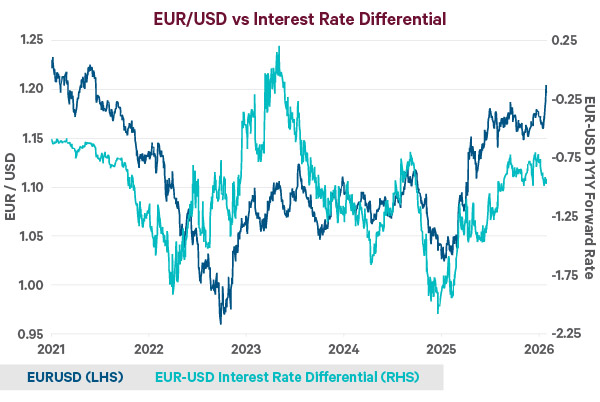
Source: Bloomberg as 29/01/2026. Note: EUR-US interest rate differential = difference between EUR 1Y1Y forward rate and US 1Y1Y forward rate. The 1y1y forward rate is the interest rate you can lock in today for a one-year loan that starts one year from now.
- The US dollar has continued to depreciate versus the euro in 2026, following on from a significant weakening of the dollar in 2025.
- The relationship between the EUR/USD exchange rate and the EUR-US interest rate differential has broken down recently. The euro currency has been strengthening despite reduced rate differential support.
- The Trump administration continues to remind us that a weaker exchange rate remains an explicit policy goal. A weaker exchange rate makes US goods more competitive abroad and boosts corporate earnings.
If you would like to stay up to date on the latest macro information, subscribe to this newsletter to receive it straight to your inbox every Monday.