US equities edged lower last week due to concerns about the potentially disruptive impact of artificial intelligence and heightened global trade and tariff uncertainty. Markets were rattled by a Citrini Research report suggesting AI agents could disrupt industries such as software, asset management, and banking, potentially driving significant unemployment. Many linked Monday’s decline to the report. Nvidia delivered strong earnings on Wednesday, but the reaction was muted. CEO Jensen Huang pushed back against fears that AI agents will undermine enterprise software, arguing that markets have overstated the risk.
In Europe, German business sentiment improved more than expected in February, reaching its highest level since August. Eurostat confirmed euro-area inflation at 1.7% in January. In the UK, consumer confidence dropped in February, partially due to a rise in unemployment. In Japan, services-sector inflation rose to 2.6% in January, with wages from a tight labour market adding inflationary pressure.
Last week's highlights
 |
- Conference Board Consumer Confidence (24/02) - Consumer confidence rebounded more than expected in February.
- Producer Price Index - Unexpectedly accelerated in January, coming in at 0.5% month over month vs 0.3% forecast.
|
 |
- Germany IFO Survey (23/02) - German business morale rose slightly more than expected in February, reaching its highest level since August.
- Eurozone January Inflation Final Estimate (25/02) – Eurostat confirmed inflation in the euro area stood at 1.7% in January.
|
 |
- GfK Consumer Confidence (27/02) – Dropped in February, partially due to a rise in unemployment.
|
 |
- Japan Services Inflation (26/02) – Japan services sector inflation came in at 2.6% for January, rising wages from a tight labour market are putting inflationary pressure on the economy.
- Japan Industrial Production (26/02) – Rose by 2.2%, less than the 5.3% forecast.
|
This week, developments in the Middle East will dominate headlines. For equity markets, the initial reaction has been negative, but only a severe and sustained oil disruption would imply substantial consequences for global growth. Key US data releases include the ISM manufacturing and services PMIs, which have recently indicated a cyclical rebound, and Friday’s nonfarm payrolls. In the Eurozone, investors will receive inflation and labour market figures. The UK’s S&P Global Composite PMI is due out Wednesday. In emerging markets, Brazil reports Q4 GDP and China releases its manufacturing PMI.
What's on the radar
|
- ISM Manufacturing & Services PMI (02/03 & 04/03)
- Initial Jobless Claims (05/03)
- US Nonfarm Payrolls (06/03)
|
|
- HCOB Eurozone Manufacturing PMI (02/03)
- Eurozone Inflation (03/03)
- Eurozone Unemployment Rate (04/03)
|
|
- S&P Global Composite PMI (04/03)
|
|
- China Manufacturing PMI (04/03)
- Brazil Q4 GDP (03/03)
|
Chart of the moment - A market of stocks, not a stock market
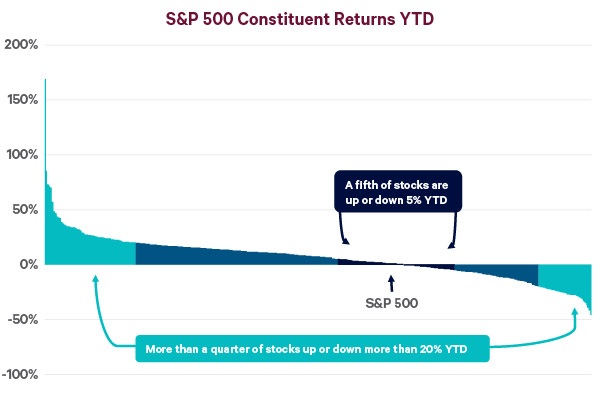
Source: Bloomberg, February 2026. S&P 500 constituent returns measured in USD.* Return as of 26/02/2026.
- Since the beginning of the year, concerns over the impact of artificial intelligence have broadened leadership in the S&P 500, resulting in a wider dispersion of returns across its constituents.
- More than a quarter of companies have seen their price increase or decrease by 20% in 2026, despite muted index returns.
- The modest move in the index has masked the elevated volatility at single-name level.