The start of 2026 has delivered a mix of geopolitical tension, volatile headlines, and pockets of strong market performance. In moments like this, staying disciplined matters more than ever. Our core message to investors remains simple: stay invested, avoid reactive decisions, and remain focused on the long‑term plan.
Elevated Risks but Contained Impact
Recent tensions in the Middle East have pushed energy markets into sharper focus, particularly the risk of disruption through the Strait of Hormuz. Approximately 20% of world oil supply comes through the Strait of Hormuz, however, our base case is that any interruption to supply would likely be temporary.
Certainly, the oil price is going to spike, but we expect it to remain well below the $139 seen in 2022 after Russia invaded Ukraine, and the all -time high in 2008 of $147.50. The oil spike will not cause a recession, unlike between 1973-1974 after the first oil crisis, or even between 1990-1991 after Saddam Hussein invaded Kuwait. The primary reason for this is the US shale production revolution. On top of the global economies lower dependance on Middle East oil, OPEC+1 retains spare capacity, China has built significant strategic reserves, and a strong US presence in the region should help limit the duration and scale of any shock.
Crucially, the global economy is now structurally less sensitive to energy price spikes than it was previously. Unless oil prices remain elevated for a prolonged period, we expect only a limited impact on inflation or central bank policy. The US remains less exposed than major importers in Europe and Asia.
History also offers important perspective. Geopolitical shocks often generate short‑term volatility, but unless they evolve into sustained economic disruptions, they do not bring about global recessions. The markets typically refocus on fundamentals; growth, earnings and liquidity.
A Strong Start to 2026 for Risk Assets
Despite a volatile January, global equities have begun the year positively, with Europe and Emerging Markets leading the way. Better‑than‑expected economic data, moderating inflation, and easier financial conditions, particularly in the US, have supported sentiment.
We maintain a tactical overweight to Emerging Market equities, which continue to offer attractive valuations and strong earnings prospects. Additional tailwinds include a gradually weakening US dollar and rising foreign investor flows seeking alternatives to US mega‑caps.
Bond markets, meanwhile, have been more muted, but we expect sovereign and corporate bonds to continue to provide defensive qualities within multi‑asset portfolios especially shorter‑dated and higher‑quality credit.
Gold and oil have rallied, supported by elevated geopolitical risk, strong demand, and ongoing central bank buying.
What Market History Tells Us
Looking across major geopolitical events over the past 70 years, markets have often shown resilience. While short‑term drawdowns are common, 12‑month equity returns have historically been positive in most cases, especially when not accompanied by a recession. This pattern reinforces the importance of avoiding emotional, headline‑driven decision‑making.
Figure 1: S&P 500 and Geopolitical Events
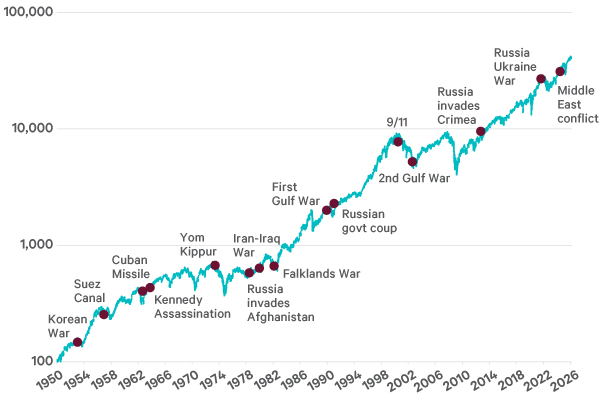
Source: Bloomberg, NBER Returns are S&P 500 price returns measured in USD. S&P 500 is in log scale, based at 100.
Our Current Positioning
Our message is:
- Stay invested and avoid reactive de‑risking
- Expect safe‑haven rallies likely to be temporary
- Use volatility as an opportunity to rebalance and diversify
- Look to global opportunities across areas such as Emerging Markets, Latin America, Europe, gold, and diversifying alternative strategies
While the backdrop remains uncertain, the underlying economic and market fundamentals remain supportive. Maintaining discipline, diversification, and a long‑term perspective remains the most effective approach.
1OPEC+ refers to the alliance between OPEC and a group of major non‑OPEC oil‑producing countries, including Russia, formed in 2016 to coordinate production decisions and help stabilise global oil prices.