Bonds are the cornerstone of global financial markets and are part of the US$145.1 trillion fixed income universe. They are a source of funding for governments and companies and a key component of investors’ portfolios. They come in a wide range of forms with varying maturities and credit qualities allowing investors to change their exposures depending on what interest rate or credit risk they wish to take.
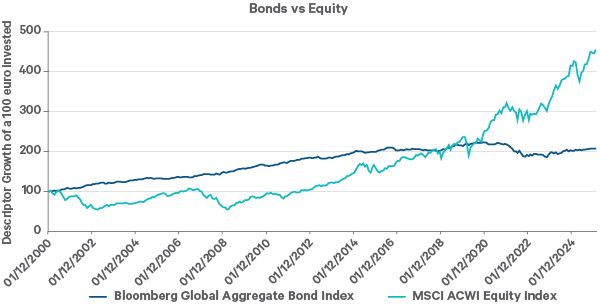
Bonds play a key role in well-constructed portfolios, with the overall exposure to the asset class depending on an investor’s risk appetite and investment time horizon. They are viewed as a more predictable source of return than equities, as seen in Figure 1, making them an attractive choice for investors seeking lower risk investment solutions. As a result, bonds are often an attractive option for investors seeking capital preservation, reduced volatility, or a reliable income stream.
Figure 1: Comparison of bond and equity returns
Source: Bloomberg, February 2026
Currency positioning
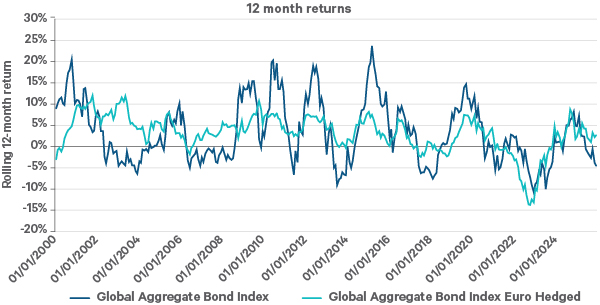
Euro-based investors generally hedge out all non-euro currency exposure from their bond holdings to give more certainty on the level of future returns. (For example, the US dollar weakness in 2025 where the currency depreciated greatly versus the euro would have had a dramatic effect on the value of a supposedly low-risk bond portfolio). The volatility reduction of currency hedging through time for bond holdings is shown in Figure 2 below, where the range of 12-month returns is greatly reduced. If left unhedged, currency movements could potentially be the main driver of returns for bond investors in certain periods given the low return profile of the asset.
Figure 2: Rolling 12 month return for a hedged and unhedged global bond index.
Source: Bloomberg.
The role of bonds
Traditionally, bonds within a multi-asset portfolio have had three main characteristics:
1. Diversification: Bonds can move differently to equities providing investors with a cushion during market downturns. The main diversification benefit relative to equities comes from government bonds as they have historically been a safe-haven asset while equity markets are in a stress period. The correlation between stocks and bonds is a key component in determining the level of risk a portfolio runs. When they are negatively correlated an investor can hold more equities which increases the expected return of portfolios.
2. Income: Income can be generated through the yield received by holding bonds. This can be increased by owning lower credit quality bonds or by holding longer dated bonds, for which an investor will demand a higher yield.
3. Capital preservation: Bond returns are typically much more muted than equities, especially high-quality bonds which can be a defensive anchor in a portfolio during down periods in markets.
These characteristics of bonds do not always hold through time and depend on the broader macroeconomic environment.
For example:
- stocks and bonds can sometimes move in the same direction during inflation shocks,
- the income component can be negligible when bond yields are low,
- bonds can experience large drawdowns during sharp interest rate hiking cycles which increases their volatility.
Recent experience
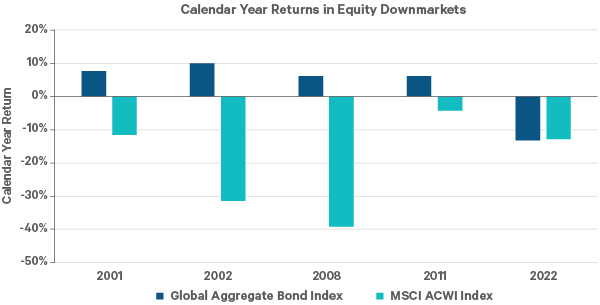
The reality for bond holders is that a euro-hedged diversified government and corporate bond fund’s 5-year total return to 31st December 2025 is circa.-7.0%1, a performance that doesn’t show an asset class with a smooth return profile. Investors post dot-com bubble could take comfort from the fact that bonds and equities generally were negatively correlated in times of market turmoil and bonds would act as a ballast in portfolios, as seen in Figure 3.
Bonds, in particular government bonds, were seen as a ‘risk-off’ asset, somewhere to which investors could allocate when risk appetite was low, and the economic outlook was uncertain. The first two decades of the 2000s had no sustained inflation shock to deal with. In the calendar year 2022, however, that relationship changed.
Figure 3: Bond portfolios during equity market downturns
Source: Bloomberg.
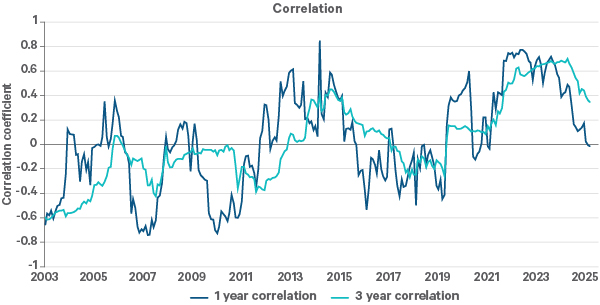
Figure 4 shows us that the return of a high inflationary period caused the correlation between equities and bonds to increase, and to switch to a positive relationship. That positive relationship is not unusual in a historical context: Bonds and equities for the most part moved in the same direction in the 20th century where the absolute level of inflation was higher than that experienced in the 21st century up until 2022. For investors, the simultaneous drop in both equities and bonds, caused lower-risk portfolios to draw down to a similar extent to higher risk ones.
Figure 4: Correlation between equity and bonds.
Looking forward
A pertinent question is how investors should think of bonds in the years ahead when allocating. It is prudent to view them as a lower risk asset and not necessarily as ‘riskless’ or ‘risk-free’. The implication of this to portfolio construction is that to maintain the same level of risk as when assuming a negative correlation, an investor may wish to reduce their exposure to equities or bonds overall and hold other diversifiers. These diversifiers for investors include a variety of assets, like commodities (e.g. gold), property, hedge funds or absolute return funds – strategies that aim to provide returns which are not dependent on the equity or fixed income markets.
Overall, a well-constructed and balanced portfolio will have a dedicated allocation to bonds to reduce overall risk in the portfolio and to smooth out an investor’s experience across a full market cycle. Investors may have to hold less equities or bonds when the two are positively correlated, with the aim of reducing the losses caused by a simultaneous drawdown in both asset classes. The end (for now) of a super low or negative interest rate environment does, however, mean that investors are being compensated for holding bonds once again.
1 The euro hedged return for the Bloomberg Global Aggregate Bond Index.
Market data