US equities finished higher for the week, boosted by strong earnings from Nvidia and a pullback in oil prices. At Jackson Hole, Kevin Warsh reaffirmed the Fed’s commitment to its 2% inflation target and warned that further policy tightening is possible if inflation does not return to target “clearly and at sufficient speed”. Warsh did not provide forward guidance, but markets are now pricing about a 60% chance of a rate hike at the Fed’s September meeting following his remarks. The Fed’s preferred inflation measure, Core PCE, came in at 3.3% year-on-year, in line with forecasts. Q2 US GDP growth was confirmed at an annualised 1.5%, unchanged from the first estimate.
Germany’s Q2 GDP growth was revised up to 0.3%, driven mainly by stronger exports, while business sentiment reached its highest level in a year. The Brazilian unemployment rate fell from 5.8% to 5.3% in Q2, in line with expectations. Tokyo Core CPI increased 1.8% year-over-year, above the 1.7% forecast and getting closer to the Bank of Japan’s 2% target.
Last week's highlights
 |
- Core PCE Price Index (26/08) – Came in at 3.3% as expected.
- Jackson Hole Economic Policy Symposium (27/08 – 29/08) - Warsh stated that further policy tightening is possible if inflation does not return to target “clearly and at sufficient speed”.
|
 |
- Germany Q2 GDP (25/08) – Grew by 0.3%, ahead of July preliminary reading of 0.2%. German business sentiment hit its highest level in a year.
|
 |
- UK car production (27/08) – Declined 11% year over year in July, in line with a fall in exports.
|
 |
- Brazil Unemployment Rate – July (27/08) - Fell from 5.8% to 5.3% in Q2, in line with expectations.
- Tokyo Core CPI (28/08) – Rose 1.8% year over year, above 1.7% forecast and getting closer to the Bank of Japan’s 2% target.
|
Looking ahead to this week, investors in the US will receive several data points on the labour market including JOLTS job openings, nonfarm payrolls and ADP employment data. In the Eurozone, August inflation figures will be in focus ahead of the ECB's September meeting, where policymakers are expected to raise interest rates. The Reserve Bank of New Zealand will also meet this week and are expected to hike rates while the Bank of Canada are expected to hold rates steady.
What's on the radar
|
- ISM Manufacturing & Services PMIs (01/09 & 03/09)
- JOLTS Job Openings (01/09)
- ADP Nonfarm Employment Change (02/09)
- Nonfarm Payrolls (04/09)
|
|
|
|
|
|
- China Manufacturing PMI (31/08)
- Reserve Bank of New Zealand meeting (02/09)
- Bank of Canada meeting (02/09)
|
Chart of the moment - Long bonds are the only ones moving
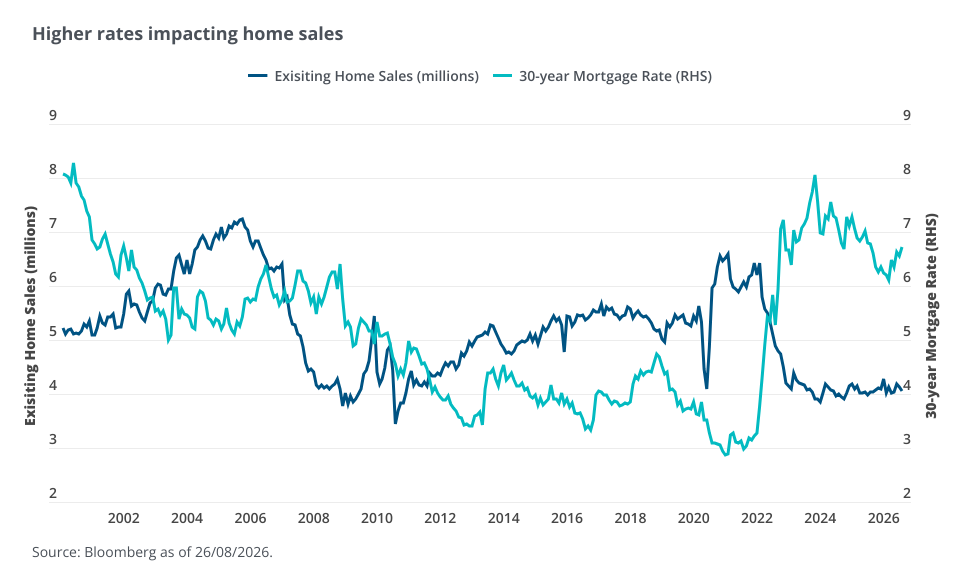
Note: Mortgage rate shown is 30 year fixed national average.
- US home sales have been subdued recently as high mortgage rates have restrained potential homebuyers.
- Mortgage rates have been rising alongside long-term Treasury yields due to concerns about inflation, fiscal deficits and growing US national debt, which now exceeds $40 trillion.
- The US Treasury has attempted to ease pressure on long-term bond yields by increasing buybacks, funded by increased issuance of short-term bonds.