Introduction
Davy is Ireland’s leading provider of wealth management and investment banking services. This year we celebrate our centenary, a timely opportunity to reflect on the firm’s evolution since its establishment as a small stockbroker in Dublin’s city centre in 1926. Our early decades played out against a backdrop of profound economic and social change, with the disruption of the old wealth order post-Independence benefiting our business hugely. There have been many economic cycles and market events since, with the most remarkable structural change in our sector in recent decades being the gradual rise of wealth earned, owned and/or directed by females. As part of our Wealth in Ireland series, and aligned with International Women’s Day, this insight seeks to profile the nature of this change, using public as well as proprietary insights.
Drivers of change
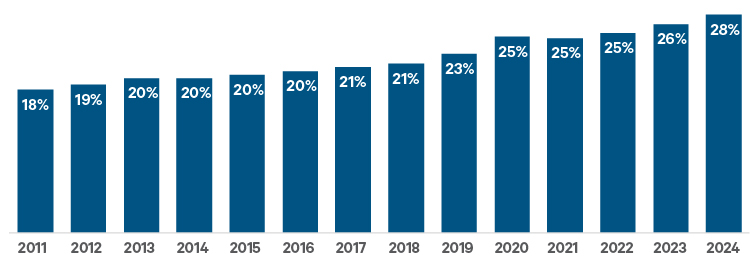
Three factors underpin the rise of female wealth in Ireland, with labour force participation and performance the most significant. While the participation gains were not spectacular, rising from 54% to 61% in the 20 years to end-2025, they coincided with strong growth in educational attainment and an almost equivalent decline in male participation. Female presence among the highest earning professionals in Ireland has grown, with law and medicine examples of two professions where women are now in a majority. While the glass ceiling is far from shattered, with gender pay gaps persistent, women account for a significant and rising share of the best paid jobs in Ireland (see Figure 1).
Figure 1: Female share of the top 1% of employments in Ireland
Source: Central Statistics Office
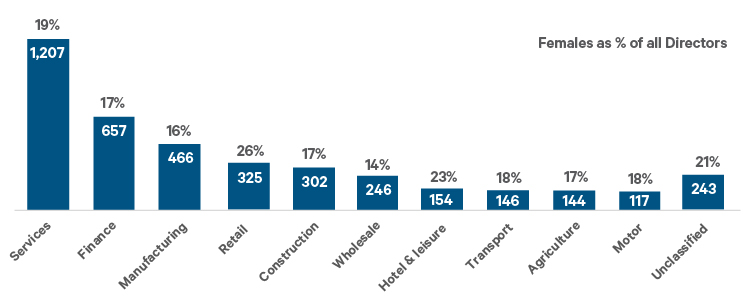
Women have also made gains in business ownership, with our analysis of Company Registration Office (CRO) filings for 2024 indicating that one fifth of Irish businesses are at least part owned by women (see Figure 2). Business owners are the wealthiest category of household in Ireland, with their net assets more than twice the national average in 2024.
Figure 2: Females directors of Irish companies (value > €1 million < €100 million)
Source: CRO (Davy derived)
While there has been clear progress, there is a sectoral skew towards service-based enterprise and away from more capital or research-intensive activities where the opportunity for value creation may be greatest. An analysis of Davy M&A data in recent years validates this view with a small share of total business sale proceeds accruing to female owners.
There are timing factors here, with successful business build often taking decades.
The final factor is inheritance, with the confluence of a fast growth in household wealth and its concentration in an older population meaning a significant transfer of wealth in the coming decades. The size of this transfer will depend on rates of asset appreciation and the costs of elder care. We estimate transfers of between €140 billion and €240 billion to the end of 2035. This is significant in the context of national household wealth of €1,320 billion at end- 2024. Inheritance is inherently distributive, with women benefiting disproportionately given their longer life expectancy and historical under-representation in Irish wealth ownership.
Rising force
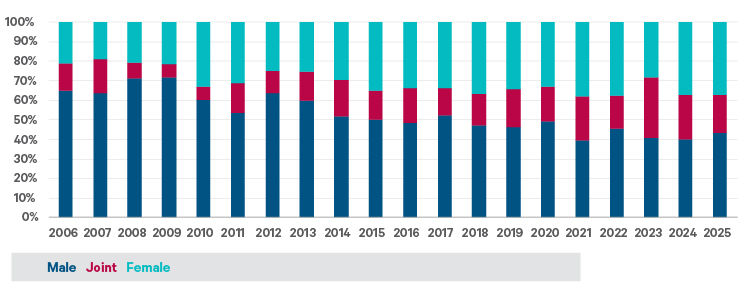
At Davy, our advised services are designed for what are termed 'High Net Worth' individuals who account for a small proportion of the population but a high share of national wealth. These are primarily business owners, high-earning professionals and individuals with acquired wealth. There are many ways to examine the gender profile of our business, with the simplest being to examine the legal ownership of the assets which we manage on behalf of clients (beneficial owner basis). This examination shows a steady feminisation, underpinned by progressive change in the share of our new clients accounted for by females and by joint relationships (see Figure 3).
Figure 3: Gender profile of new Davy clients (advised only)
Source: Davy
As at the end of 2025, females made up 31% of clients in our advised business (Davy Private Clients) with joint relationships contributing an additional 19%. This was the first year in our history when females were party to more than half of our client relationships.
Males were party to close to 70% of our client relationships in the same year.
In matters of wealth, however, time is often your greatest ally. Females are disadvantaged here, with their average Davy tenure significantly shorter than that of males. Partly as a result, their share of the funds on which we advise is lower than their share of our client base. In other words, the average wealth owned by our female clients is less than that of male clients. This too, however, is changing with the rate of growth in funds in accounts owned by females and jointly growing faster than our non-corporate book in total (see Figure 4).
Figure 4: Gender profile of funds under management (advised Davy clients)
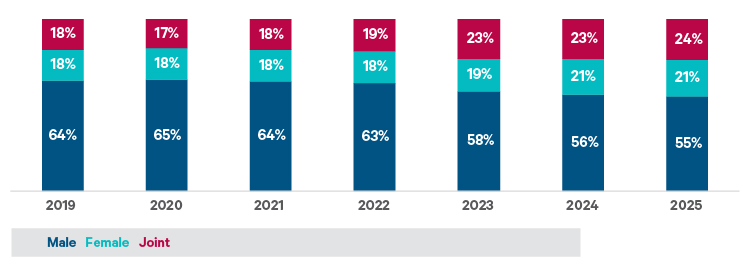
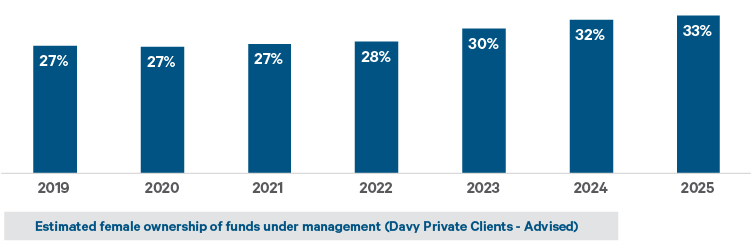
In 2025, female clients accounted for just over 20% of Davy’s funds under management with joint relationships making up an additional 24%. Splitting joint accounts equally (based on an even mix of genders across all accounts taken together), the female share of the wealth on which Davy advises has been rising steadily (see Figure 5).
Figure 5: Estimated female ownership of funds under management (advised Davy clients)
Source: Davy
Beyond our advised wealth management services, and in line with international norms, females feature less in the client profile of our business lines where clients select and manage their investments without expert support. Several factors influence this, with confidence, time availability, and engagement levels the main drivers. In our experience, females benefit disproportionately from access to expert advice. Close to 90% of our advised female clients reporting a good or sophisticated market understanding. The share reporting a 'sophisticated' knowledge is, however, low in absolute and relative terms.
Capable and committed
While much has been written about the distinct nature of the female investor, our experience is that gender is less determinant of behaviour than other characteristics such as employment status, means of wealth acquisition, age, and related beliefs around wealth trajectory.
Common, but far from universal, features of Davy’s female clients include:
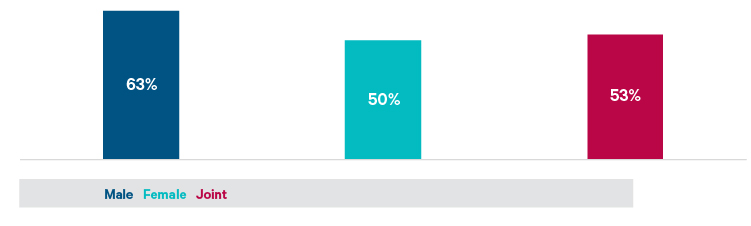
Females are moderately more risk adverse in their attitudes and portfolio holdings, partly due to a lower-than-average (primary relationship) representation in our business owner segment where risk appetite levels are typically highest (see Figure 6).
Figure 6: Percentage of clients by gender with higher risk attitude (advised Davy clients)
Source: Davy
Females place a higher reliance on Davy investment experts for the active management of their portfolios, with often positive implications for fund performance longer-term. Females are also diligent around, and committed to, the initial and ongoing advisory process, with great stock placed on the quality of the advisor relationship and high related loyalty. In summary, they count amongst out most committed and capable investors.
Many clients, male and female, are less than confident around investing when they first come to Davy. New female clients are more likely to articulate this early stage, with men more inclined to not articulate it or do so when the initial process is complete. Investment confidence builds gradually, with no sustained capability difference between the genders in our experience.
There are several misconceptions around female investors, certainly in our experience. The first is that female clients prefer to deal with and/ or do better with female advisors. This is not the case at Davy, with many of our most successful client relationships crossing gender lines. The second is that females are more likely to choose sustainable investments. Data on the investment preferences of our clients indicate no material difference.
Wealth equality
There are fundamental changes at play around female ownership and control of wealth in Ireland. The trends that we see in our advised business are in evidence in other countries, underpinned by a combination of factors including a higher share of national enterprise and earnings, shifting social patterns with females assuming greater importance in the management of family resources and population ageing, which will result in the significant transfer of wealth to females (often in their older years) in the coming decades.
The share of national wealth owned by females, as indicated in our advised client base, is in line with estimates for other developed countries at more than 30% in 2025. While the pace of change is steady, there are a series of factors which indicate that full wealth equality in Ireland is still a distance away and will require very concerted policy efforts to become a reality. The first of these is persistent gender pay and pension gaps, with female business ownership likely the single most important factor from a wealth perspective. The second is timing, with existing holders of wealth inherently advantaged in their ability to generate additional wealth by virtue of compounding. The third is access to financial planning and investment expertise, with females benefiting disproportionately from advice for a combination of reasons.
Estimates of when full wealth equality will become a reality in Europe vary significantly, with the definition of wealth ownership important. Taking a broad definition as wealth which is individually or jointly owned, the run rate of change in our advised business speaks to 15 to 20 years for wealth equality, with much depending on inheritance patterns. Equality of wealth ownership could be a reality by 2040.
Equality in the ability to independently generate wealth is, however, likely much further away speaking as it does to the more fundamental features of gender roles in our society and the related need for transformative policy interventions particularly around business ownership. Failure to address this inequality will have implications not just for women but for our national economic prospects.
Beyond Davy
This report analyses the gender distribution of wealth in our business. We are conscious of different wealth dynamics beyond our market and business, where access to employment, enterprise opportunity and expert planning supports may be different. Our analysis is, therefore, not intended to be definitive for the full market rather to contribute to a broader national conversation on female wealth against the backdrop of the Davy centenary and International Women’s Day 2026.