US equities moved higher for the week despite mixed labour market data. Private payroll growth and nonfarm payrolls both came in below expectations, while job openings were stronger than forecast. The softer employment backdrop eased concerns around further policy tightening, supporting lower bond yields and helping equities move higher.
Over in the Eurozone, inflation eased to 2.8% in June, reducing the urgency for further tightening from the European Central Bank. In the UK, official data showed that the UK economy grew by 0.6% in Q1, as expected, with services being the main growth driver. Elsewhere, China’s manufacturing PMI came in at 50.3 in June, as factory activity grew faster than expected due to increased demand for tech exports.
Last week's highlights
 |
- JOLTS job openings (30/06) - Came in at 7.6m, above 7.3m estimate.
- ADP nonfarm employment change (01/07) - Rose by 98k, less than expected.
- Nonfarm payrolls & unemployment rate (02/07) – Cooled to 57k in June, unemployment rate dropped to 4.2% due to fall in participation rate.
|
 |
- German CPI (30/06) - German inflation softened to 2.3% in June, lower than the 2.5% forecast.
- Eurozone CPI – June Preliminary (01/07) - Inflation eased to 2.8% in June, reducing the urgency for further tightening from the ECB.
|
 |
- UK Q1 GDP (30/06) – UK economy grew by 0.6% in Q1, as expected, with services being the main growth driver.
|
 |
- China Manufacturing PMI (30/06) – Came in at 50.3 in June, as Chinese factory activity grew faster than expected due to increased demand for tech exports.
|
Looking ahead to this week, investors in the US will receive S&P Global’s Services PMI for June. Over in Europe, German inflation figures are due out. In the UK, the Halifax house price index will be released. The Reserve Bank of New Zealand will meet on Wednesday and are expected to raise rates. Finally, inflation data is set to be released in both China & Brazil.
What's on the radar
|
- S&P Global Services PMI (06/07)
- FOMC Minutes (08/07)
|
|
- German CPI - June (10/07)
|
|
- UK Halifax house Price Index (07/07)
|
|
- Reserve Bank of New Zealand Meeting (08/07)
- China CPI - June (09/07)
- Brazil CPI - June (10/07)
|
Chart of the moment - Street cred for the Fed
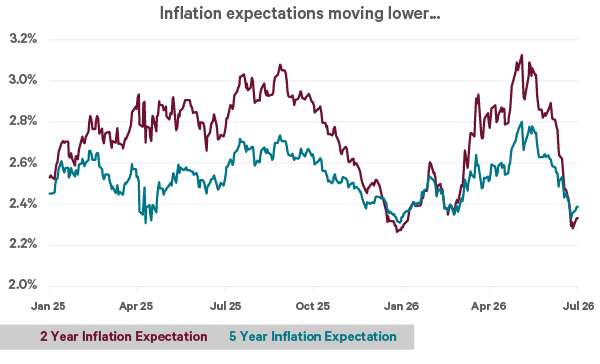
Source: Bloomberg as of 30/06/2026.
Note: Inflation swaps used for inflation expectations. Inflation swaps are a way of measuring what financial markets think inflation will be in the future, so when inflation swaps fall, it means investors expect price pressures to ease over time. For example, a 2-year inflation swap is a market-based measure of what investors expect average inflation to be over the next two years.
- US inflation expectations have moved lower in recent weeks, implying that markets expect the current inflation spike to be short-lived, a reassuring signal for the Federal Reserve's credibility.
- The shift reflects falling oil prices and some hawkish commentary from the Federal Reserve, as Kevin Warsh called persistently high prices a “burden for the American people”.
- With US midterm elections approaching, policymakers have strong incentives to prevent a temporary price shock from becoming a broader inflation problem.