US equities posted gains last week as markets continued to treat the Middle East conflict as a short-term shock for the global economy. On Friday, the US Department of Justice dropped its criminal investigation of Fed Chair Jerome Powell. This move removes a major hurdle to Trump’s nomination of Kevin Warsh to replace Powell. US retail sales rose 1.7% from the previous month, as gas station sales surged due to rising energy prices. S&P Global’s composite PMI rose to 52.0, indicating that US business activity growth recovered slightly in April. The Eurozone’s preliminary HCOB Composite PMI declined to 48.6 in April as business activity in the euro area shrank for the first time since late 2024 due to a sharp drop in the services sector. In the UK, CPI rose to 3.3% in March from 3% in February, while the unemployment rate fell unexpectedly - the drop was driven by a rise in those not actively seeking work. Elsewhere, the People’s Bank of China left rates unchanged as expected, strong Q1 economic growth data reduced the urgency for new stimulus measures.
Last week's highlights
 |
- US Retail Sales (21/04) – Rose 1.7% from the previous month, gas station sales surged due to rising energy prices.
- Preliminary S&P Global Manufacturing & Services PMIs (23/04) - Manufacturing PMI rose to a near 4-year high0f 54.0 while services PMI rose to 51.3.
|
 |
- German Producer Price Index (20/04) – Came in hotter than expected at 2.5% vs 1.4% forecast.
- Preliminary HCOB Eurozone Composite PMI (23/04) – Declined to 48.6 as business activity in the euro area shrank for first time since late 2024 due to a sharp drop in the services sector.
|
 |
- UK CPI (22/04) - Rose to 3.3% in March from 3% in February, the increase was mainly driven by fuel.
- UK Unemployment Rate (Feb) (21/04) - Fell unexpectedly, the drop was driven by a rise in those not actively seeking work - as economically inactive people are not included in the jobless figures.
|
 |
- People’s Bank of China Meeting (20/04) – Left rates unchanged as expected, strong Q1 economic growth data reduced the urgency for new stimulus measures.
- Japan CPI – March (24/04) - Headline inflation came in at 1.5% vs 1.3% in February.
|
This week, investors will be watching closely as several major central banks are due to meet. The Federal Reserve will meet on Wednesday and are expected to leave rates unchanged. The European Central Bank are also expected to hold rates steady, with markets expecting a rate hike to come in June. Similarly, the Bank of England are also likely on hold, despite last week’s higher than expected inflation print. Finally, the Bank of Japan is expected to keep interest rates steady but signal its readiness to hike them as soon as June.
What's on the radar
|
- Federal Reserve Meeting (29/04)
- Core PCE Price Index – March (30/04)
- US Q1 GDP (30/04)
|
|
- European Central Bank Meeting (30/04)
- Preliminary Eurozone CPI – April (30/04)
|
|
- Bank of England Meeting (30/04)
|
|
- Bank of Japan Meeting (28/04)
- Bank of Canada Meeting (29/04)
|
Chart of the moment - You're (not) fired
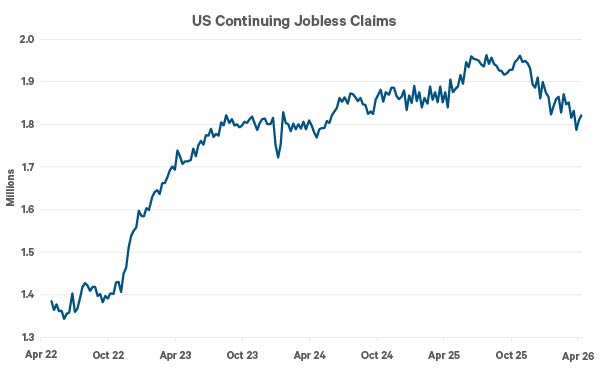
Source: Bloomberg as of 24/04/2026. Note: Units are in millions, figures shown are 4 week moving average, seasonally adjusted.
- The US labour market is showing renewed signs of strength, with continuing jobless claims falling to their lowest level in almost two years.
- The decline signals cyclical improvement in the labour market, easing investor concerns about weakness driven by geopolitical uncertainty and AI related job losses.
- The US unemployment rate has remained stable despite low job growth, as layoffs remain low.