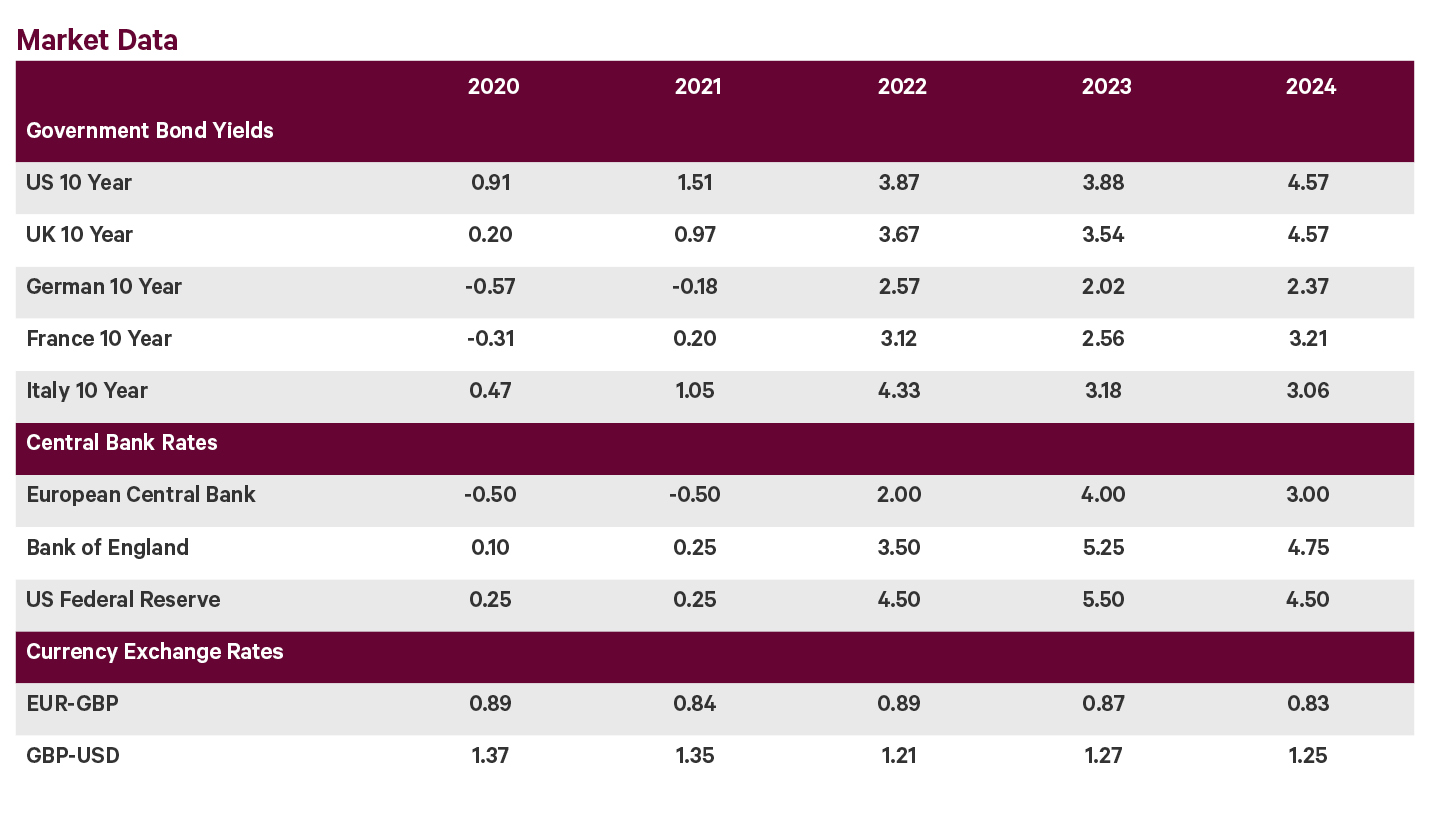
The UK’s latest budget delivered short-term reassurance to financial markets but left investors questioning the country’s longer-term growth trajectory. While the fiscal package avoided the chaos of 2022’s “mini budget,” it offered little in the way of a coherent economic growth strategy.
What was in the budget
The budget raised approximately £26bn in new taxes, including:
- Income tax threshold freeze (£8bn)
- Removal of NIC relief on salary sacrifice pensions (£4.7bn)
- 2% income tax increase on property, savings, and dividends (£2.1bn)
- Mileage-based EV tax (£1.4bn)
- Council tax surcharge on £2mn+ properties (£0.4bn)
- Reduced capital gains relief on employee ownership trusts (£0.9bn)
- Anti-tax avoidance measures (£2.3bn)
- Corporation tax write-down allowance cut (£1.5bn)
On the spending side, welfare commitments dominate with:
- Welfare up by £73bn over the coming 5 years. £20bn in disability benefits, with nearly £35bn in additional spending on older people under the triple lock policy.
- Ending of 2 child-limit on universal credit (£3bn)
- Minimum wage up: 18- to 20-year-olds have seen a 26% wage increase in last 2 years.
- Crucially there was no spending on supply side reforms or productivity-enhancing investment growth
The OBR’s reaction: Slightly improved fiscal headroom but little to encourage growth
The latest revisions from the Office for Budget Responsibility (OBR) have delivered a surprisingly modest adjustment to the UK’s fiscal outlook. While investors had braced for a deeper deterioration, the fiscal hole was revised to just £13bn, smaller than anticipated. This outcome provides some reassurance to markets concerned about fiscal sustainability.
Despite the downgrade to growth expectations, the impact is largely offset by higher inflation, stronger nominal spending and buoyant wage tax revenues. Together, these factors have enabled a £12bn increase in fiscal headroom relative to the government’s rules, effectively creating a larger buffer against future shocks.
The OBR has trimmed its growth forecast by 0.3 percentage points, now projecting 1.5% growth over the forecast horizon. While this aligns with the UK’s long-run trend, the projection may prove optimistic. From 2026 to 2029, planned fiscal consolidation is expected to subtract 0.6% from growth annually, raising questions about the sustainability of the headline forecast.
Perhaps the most striking element of the OBR’s commentary was its blunt assessment of the budget’s growth impact. The watchdog noted that “none of the policy measures in this budget have a sufficiently material impact to justify adjusting our post-measures potential output forecast.” In plain terms, the budget does little to enhance long-term productivity or growth potential.
Market reaction: bonds and currency
Near-term debt issuance is now expected to exceed earlier forecasts. In 2025/26, borrowing is projected at £138bn (4.5% of Gross Domestic Product), up from £117.7bn. The following year, 2026/27, issuance is set to reach £112.1bn (3.5% of GDP), compared with the prior estimate of £97.2bn.
The government’s fiscal consolidation remains firmly backloaded. Borrowing only falls below previous expectations in 2029/30, when issuance is forecast to decline to £67.9bn, representing 1.9% of GDP.
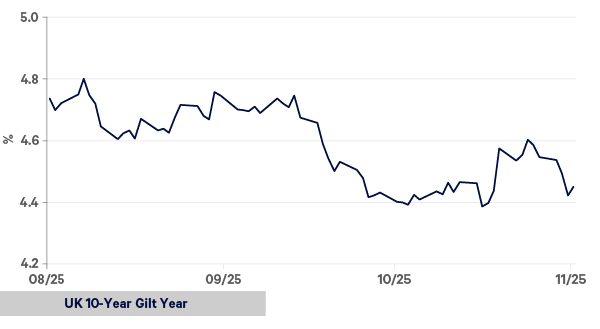
- Gilts rallied post-budget, likely a relief rally.
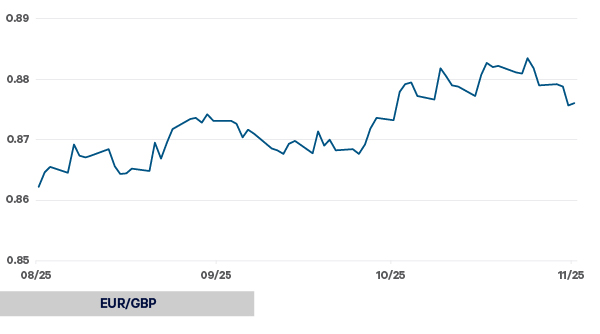
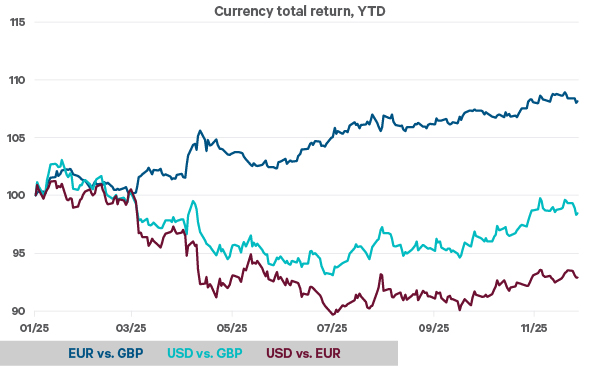
- Sterling weakened initially versus the euro on the release of OBR projections before recovering as the Chancellor’s speech continued. Overall, moves have been muted. A sharp selloff in sterling was avoided yesterday, however the uninspiring growth outlook is likely to limit future sterling appreciation versus the euro in the medium term.
- Monetary policy: a slowing labour market and weaker growth will likely see the Bank of England lowering interest rates in the face of this difficult growth trajectory. UK interest rates likely to be heading lower, with terminal rates between 3% to 3.5%.
Figure 1: UK Gilt yields fall in relief (3-month chart)
Source: Bloomberg, Davy. As of 27/11/25
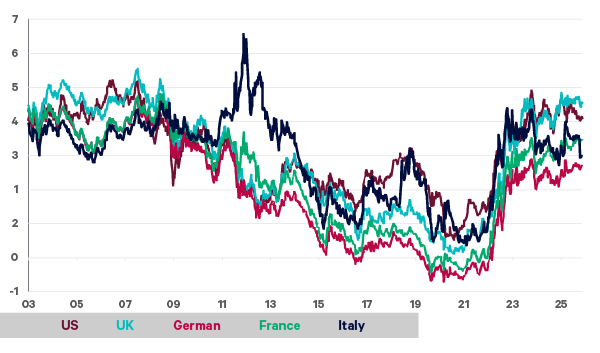
Figure 2: However, 10-year Gilts yields remain elevated (vs. US, German, French & Italian bond yields)
Source: Bloomberg, Davy. As of 27/11/25
Figure 3: Sterling relief rally - EUR/GBP spot level (3-month chart)
Source: Bloomberg, Davy. As of 27/11/25
Figure 4: Sterling remains weak vs. Euro, but doing better vs. USD
Source: Bloomberg, Davy. As of 27/11/25.
Note: performance is normalised to 100 as of 31/12/2024
Figure 5: Interest rate expectations – market expecting rates to fall to 3.5% next summer

Source: Bloomberg, Davy. As of 27/11/25
Key Budget 2025 takeaways
- Tax hikes have dominated Budget 2025. However, most of the hikes are backloaded towards the end of the current parliament (2029/30).
- The upside is that there is no new drag on 2026/27 economic growth.
- By 2029, 24% of the UK’s working population will be paying the 40% higher tax rate. However, bond markets will query whether it will be politically feasible for the government to put up taxes walking into a general election.
- Political considerations trumped economic ones - this was a budget by Labour for Labour MPs.
- The Autumn Budget does little to encourage additional economic growth going forward.
- Lower economic growth and inflationary pressure will see the Bank of England cutting interest rates closer to 3% by end of 2026.