The first equities issued can trace their roots back to 1602 when the Dutch East India company offered shares of its business to the public, by all accounts the world’s first initial public offering (IPO). For government bonds, you can trace their lineage back to 1171 when the Republic of Venice issued the inaugural note to fund their war with the Byzantine empire – although primitive forms of bonds have been traced back to Mesopotamia in 2400 BC, etched on stone tablets.
Then there’s gold. For thousands of years gold has been the object of obsession for countless civilisations. From the Ancient Egyptians to modern central bankers its influence has been ubiquitous throughout the story of humanity. Aristotle used gold to represent perfection, gold wedding rings symbolise eternal and everlasting love, and the Olympic Games reward elite athletes with gold medals as the top prize. But how did gold rise to the apex of the monetary system? Why has gold survived while revolutions have raged and societies have crumbled? What are the enduring qualities that make gold, to this day, an integral part of the financial ecosystem? Given recent volatility in the price of gold we thought it was a good time to revisit the most precious of all metals.
Humble beginnings
In ancient Mesopotamia, modern-day Iraq, the Sumerian civilisation buried their ruling class with gold jewellery to signify immortality. Although the Sumerians never adopted the precious metal as a means of exchange, their reverence for gold foreshadowed the importance it would assume in Egypt. Grains and copper were used by the Egyptians to handle everyday transactions, gold served a more prestigious role in trade as a symbol of wealth and power in diplomatic exchanges and offerings to the pharaoh. It was the Lydians of western Anatolia, in what is now modern-day Turkey, who minted the first gold coin, recognising the metal's malleability, durability, and radiance, cementing its role as a means of exchange and reliable way to preserve wealth. Gold as money spread throughout the Mediterranean.
Following the Roman invasion, Britain was fully integrated into the imperial monetary system. Centuries later, Sir Isaac Newton, in his role as Controller of the Royal Mint would unintentionally set Britain on the path toward a gold-based monetary system when he fixed the exchange rate between gold and silver. This made gold more attractive than silver, causing Britain to drift towards a de facto gold standard.
The gold standard
From the 19th century onwards the Gold Standard emerged as the dominant monetary system. It became the international standard in the West, from Moscow to Washington, with London acting as the system's financial hub and principal repository of gold reserves. But within this shiny new system, hid an implicit assumption that exchange rates between the currencies of major countries would never change. By linking their currencies to gold prices, countries gave up control over their own monetary policy in favour of free trade and capital mobility. Financial crises were the frequent result; from 1876 at the height of the classical Gold Standard, until the system collapsed in 1914.
The interwar period (1918-1939) saw attempts to restore a gold-based monetary system. The United States, Britain, and several other countries returned to the gold standard in the late 1920s. However, the global financial crisis of the Great Depression in the 1930s, which some economists partly attribute to the return of the gold standard, ultimately brought the system to an end. From 1935 until the onset of the Second World War, the United States operated a monetary system in which the dollar was no longer freely convertible into gold by the public. The Banking Act of 1935 centralised the Federal Reserve’s authority, laying the foundations of modern monetary policy.
The Bretton Woods system emerges
Following World War II, at a time when the world was seeking stability, 44 countries signed the Bretton Woods Agreement, establishing a new monetary system. Like the Gold Standard before it, exchange rates of major currencies would be fixed, but this time currencies were pegged to the US dollar. In turn, the United States committed to converting dollars into gold at a fixed rate of $35 per troy ounce. Through all the trouble and turmoil that preceded it, gold still found relevancy in the global monetary system. This change helped cement the US dollar as the global reserve currency, but the cracks in the system were clear. Demand for dollars grew globally, then as more dollars circulated worldwide, more countries would convert their dollars to gold. By the 1960s, US gold reserves were draining fast. In 1971, President Nixon brought the Bretton Woods system to an end. By ending the dollar’s link to gold, this marked the end of the gold’s formal monetary role and ushered in the modern fiat1 currency regime.
Finding an identity
Relieved of its duties and void of purpose, the influential metal was at a crossroads. Fade into obscurity, as grains and copper had before, or reinvent itself. From the anchor of the financial system to another asset free to float on the open market. Throughout the late 1960s and 1970s, the US experienced chronic inflation. War in Vietnam, Iranian oil shocks and profligate domestic spending created an economic malaise. Inflation had risen 103% over the course of the decade. And this is where gold found its new identity. An inflation hedge. Fears that the fiat system was spiralling out of control drove unprecedented demand for gold, with the price increasing from its $35 peg to $524 per troy ounce by Christmas 1979 – an almost 15-fold increase in price.
Gold gained another key characteristic before the US-Iranian hostage crisis and the Soviet invasion of Afghanistan: its reputation as a safe-haven asset. At times of heightened geopolitical tensions, central banks around the world would buy up gold. The price of gold wouldn’t surpass its 1980 peak until almost 3 decades later, on the eve of the Global Financial Crisis.
Modern portfolio adoption
Robustness during times of crisis helped embed gold in the conversation of modern investors. Building a well-rounded portfolio necessitates diversification. When crisis consumes the equity market, gold has often provided protection to the portfolio. But with gold it’s never a smooth path. Multi-decade long drawdown periods have been common in its post-1971 history. $100 dollars of gold, bought shortly after the collapse of the Bretton Woods system would be worth around $9,900 today. Had you bought a broad basket of global equities through this period you would have netted around $14,100. Investors who bought gold on the eve of some major financial catastrophes, including the Dot-Com Bubble, the Global Financial Crisis, and the Covid-19 pandemic, and held to today would have fared better than those who bought stocks. As a safe-haven asset, gold has historically proved to be a robust diversifier to global equities.
Figure 1. Annualised Asset Class Returns since the onset of certain crises
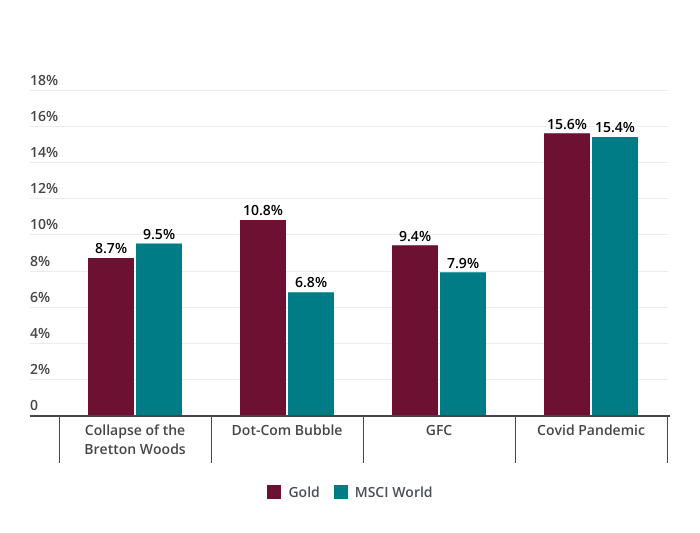
Source: FactSet, Davy. This chart depicts the annualised total returns in US dollar from the onset of certain crises to the end of June 2026. Collapse of the Bretton Woods (31/08/1971), Dot-Com Bubble (30/04/2000), Global Financial Crisis (30/09/2007), Covid Pandemic (29/02/2020).
Recent moves
From the end of 2024 to February 2026, the price of gold rose 100%. Since February it has given back around 23% of those gains. Much of the initial appreciation in price can be attributed to central banks from China, Turkey and Poland stockpiling the precious metal. The sharp reversal coincided with the election of a new Chair of the US Federal Reserve who aimed to restore confidence in US monetary policy, as well as countries, such as Turkey, being forced to liquidate reserves to fund emergency measures following the outbreak of the Iran war. Acute market dynamics can temporarily nullify the defensive characteristics we associate with gold. Still, central bank demand and geopolitical fragmentation support a strategic allocation.
Conclusion
Gold's role has evolved dramatically over the past five thousand years. It has served as decoration, currency, a monetary anchor and, more recently, a component of investment portfolios. Yet the underlying reason for its durability remains unchanged: unlike paper money, its supply cannot be created at the stroke of a keyboard. Whether held by ancient pharaohs, central banks or modern investors, gold continues to derive its value from scarcity, trust and its ability to retain purchasing power during periods of economic uncertainty. These characteristics have underpinned gold's long-standing role as a portfolio diversifier across different market cycles.
Market performance (total return % change in local currencies unless otherwise stated)
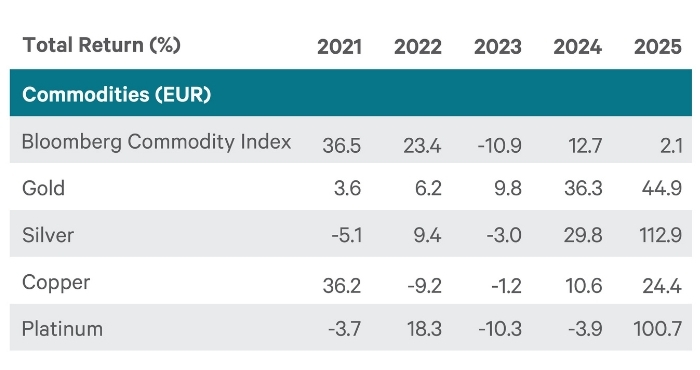
Source: Data is sourced from Bloomberg as at market close 31st July 2026 and returns are based on price indices in local currency terms, unless otherwise stated.
1Fiat currency is a government-issued currency not backed by a physical commodity like gold, deriving its value from supply, demand, and the stability of the issuing government.