US equities posted gains last week as AI optimism outweighed concerns about Middle East peace negotiations. At the start of the week, investors welcomed reports that Iran and the US had agreed to broad principles of a peace agreement. On the macro front, US consumer confidence edged lower in May as the inflationary impacts of the war intensified. The Fed’s preferred inflation measure, Core PCE, came in at 3.3%, as expected.
Over in Europe, ECB President Christine Lagarde said that the central bank is likely to raise its inflation forecast at its June monetary policy meeting. Markets are fully expecting a rate hike at the June meeting. Elsewhere, New Zealand’s central bank voted narrowly to keep rates unchanged but indicated that interest rate hikes are coming.
Last week's highlights
 |
- Conference Board Consumer Confidence (26/05) - Consumer confidence edged lower in May as the inflationary impacts of the war in the Middle East intensified.
- Core PCE Price Index (28/05) – Came in at 3.3%, as expected.
|
 |
- ECB President Lagarde Speech – ECB likely to raise its inflation forecast at its June monetary policy meeting.
|
 |
- Lloyds Business Barometer (29/05) - UK business sentiment edged up in May and is now close to its level before the Iran war.
|
 |
- Japan Tokyo CPI (29/05) - Rose 1.3% YoY vs forecast +1.5%.
- New Zealand Central Bank Meeting (27/05) – Voted narrowly to keep rates unchanged but indicated that interest rate hikes are coming
|
This week, markets will be focused on Middle East peace talks - President Trump has said that talks with Iran are ongoing, despite earlier reports that Iran had suspended negotiations. Investors in the US will also be watching the ISM’s Manufacturing & Services PMIs and the nonfarm payrolls release on Friday. In the Eurozone, preliminary inflation figures for May will be released. In the UK, S&P Global’s Manufacturing PMI is due out. Finally, the Reserve Bank of India will meet on Friday and are expected to hold interest rates steady.
What's on the radar
|
- ISM Manufacturing & Services PMIs (01/06 & 03/06)
- Nonfarm Payrolls (05/06)
|
|
- Eurozone CPI - May (Preliminary) (02/06)
|
|
- S&P Global Manufacturing PMI - May (01/06)
|
|
- Japan S&P Global Services PMI (03/06)
- Reserve Bank of India Meeting (05/06)
|
Chart of the moment - To quit or not to quit?
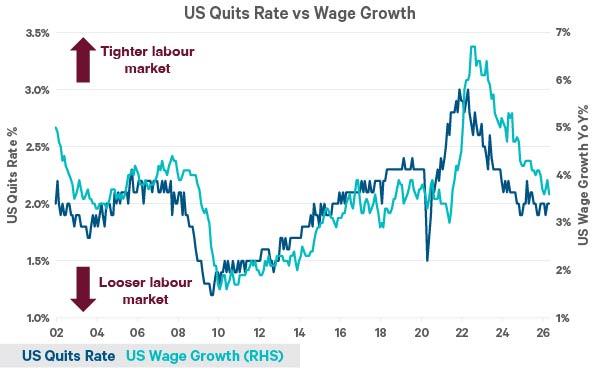
Source: Bureau of Labour Statistics, Federal Reserve Bank of Atlanta as of 30/04/2026.
Note: The Atlanta Fed's wage growth tracker is a measure of the nominal wage growth of individuals. It is the median percent change in the hourly wage of individuals observed 12 months apart.
- Inflation concerns have been rising again amid the Middle East energy crisis. One key difference between the current scenario and the 2022 inflation shock is the wages backdrop.
- Entering 2022, wage growth was accelerating strongly, the quits rate was high as workers were confident of finding a new job immediately.
- US employment expectations are now much weaker - the quits rate has fallen, and nominal wage growth has eased considerably, reducing the chance of a wage-price spiral.